Meybod
Meybod
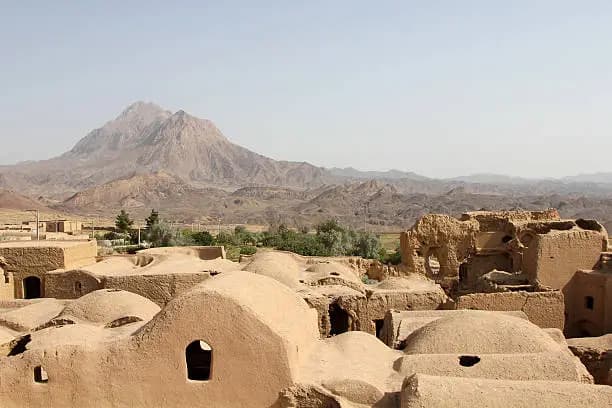
Meybod, in central Iran, preserves one of the country's best-preserved rammed-earth architectures: the Narin Qal'eh citadel, the Shah Abbas caravanserai and silk workshops to discover less than an hour from Yazd.
Meybod is an ancient city in Yazd province, central Iran, perched on the edge of the Dasht-e Kavir desert. Known for its caravanserais, rammed-earth citadels and silk workshops, it preserves raw earth architecture among the best-preserved in the country. Less than an hour from Yazd, it constitutes a dense stop in history and craftsmanship.
Practical info at a glance
- Access: bus or shared taxi from Yazd (approximately 45 km northwest); no direct train.
- Recommended duration: half a day to a full day depending on sites visited.
- Dress code: Islamic dress code mandatory (women: headscarf and covering clothes).
- Season: spring (March–May) and autumn (September–November) to avoid extreme heat.
What you'll see
Meybod concentrates several remarkably well-preserved adobe monuments. The Narin Qal'eh citadel, whose origins date back to the Sassanid era, dominates the city from an earthen mound. The Shah Abbas caravanserai, built under the Safavids, testifies to Meybod's role on the Silk Road. The ice house (yakhchal) and the dovecote (borj-e kabutar) complete a coherent architectural ensemble.
History and context
Meybod has been inhabited for at least 6,000 years, according to archaeological traces found in the region. Under the Sassanids, the Narin Qal'eh citadel served as an administrative fortress. In the Islamic period, the city prospered through caravan trade between Yazd and Isfahan. The Safavids invested heavily in the 17th century, constructing the caravanserai and strengthening hydraulic infrastructure (qanats).
Highlights of your visit
Narin Qal'eh
This rammed-earth citadel is one of Iran's oldest fortifications still standing. Its thick walls, round towers and vaulted rooms offer a direct reading of pre-Islamic defensive architecture. The view from the summit embraces the earthen rooftops of the old city and the desert beyond.
Shah Abbas Caravanserai
Built in the 17th century, this Safavid caravanserai is partially restored and accessible. Its central courtyard, iwans and merchant cells give a precise idea of caravan logistics. Some rooms now host exhibitions on local craftsmanship.
Silk and pottery workshops
Meybod is renowned for its silk weavers (pateh) and potters. Several family-run workshops remain active in the old city; it is often possible to observe work in progress and purchase directly from the artisans.
Yakhchal and borj-e kabutar
The traditional ice house (yakhchal) illustrates Iranian climatic ingenuity: a conical adobe structure allowed ice to be preserved in the middle of the desert. The cylindrical dovecote (borj-e kabutar) was used to collect guano as fertilizer, a common practice in the Yazd region.
Etiquette and visiting rules
- Wear a headscarf and covering clothes from the moment you enter the city, not just in mosques.
- Ask permission before photographing residents, particularly women.
- Do not climb unmarked sections of Narin Qal'eh: rammed earth is fragile.
Photography tips
Golden morning and late afternoon light reveal the textures of raw earth. From the top of Narin Qal'eh, the backlighting of sunset on the flat roofs is particularly striking. The silk workshops, often dark, require a bright lens or high ISO sensitivity.
Location and access
Meybod is located approximately 45 km northwest of Yazd, on the main road towards Ardakan. Shared taxis and minibuses regularly connect the two cities from Yazd's terminal. The city is flat and the old town relatively compact, but the packed earth ground can make some journeys difficult for people with reduced mobility.
In the surrounding area
- Yazd — UNESCO city known for its wind towers and adobe old town, the natural starting point for Meybod.
- Ardakan — neighboring city known for its traditional houses and qanats, a short distance to the north.
- Chak Chak — Zoroastrian sanctuary perched in the rock, approximately 70 km north of Yazd.
Frequently asked questions
Spring (March to May) and autumn (September to November) offer comfortable temperatures. Summer regularly exceeds 40°C in this desert region.
Yes, by leaving early from Yazd. Half a day is sufficient for the main sites of Meybod; you return to Yazd in late afternoon.
Islamic dress code is mandatory in Iran. For women: headscarf covering the hair and non-form-fitting clothing. For men: no shorts at historical sites.
Yes. Silk and pottery workshops are active in the old city. Purchases are made directly from the artisans, often at prices lower than those in Yazd's bazaars.
Access to the summit involves climbing packed earth and passing through narrow passages. People with reduced mobility can visit the base, but the full ascent remains difficult.
A few traditional guesthouses (adobe eco-lodges) exist in Meybod. For a wider choice, Yazd remains the recommended logistical base.
Want to discover this destination?
Our local advisors design your tailor-made trip.