Nishapur
Nishapur
Nishapur, in Iran's Khorasan region, is the birthplace of poet Omar Khayyam and Attar, and the world's turquoise capital. Between mausoleums, bazaars and medieval ruins, it offers a journey into Persia's golden age.
Nishapur is an ancient city in northeastern Iran, located in Razavi Khorasan province, roughly 100 kilometers west of Mashhad. Once a crossroads of the Silk Road, birthplace of the poet Omar Khayyam, and a major turquoise production center, it concentrates several millennia of history within a semi-arid landscape. The modern city coexists with the remains of its medieval incarnations, repeatedly destroyed and rebuilt.
Practical Information at a Glance
- Access: buses and shared taxis from Mashhad (approximately 1.5 hours' drive); no direct rail link to the city center.
- Recommended duration: a full day to cover Omar Khayyam's mausoleum, Attar's tomb, and the bazaar.
- Dress code: standard Iranian dress code (headscarf mandatory for women, modest clothing for all).
What to See
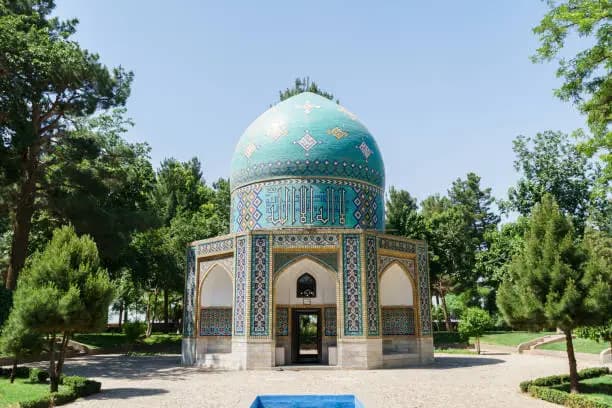
Nishapur brings together several distinct sites. The Mausoleum of Omar Khayyam, designed by architect Hooshang Seyhoun and inaugurated in 1963, stands out for its perforated concrete shell inspired by traditional latticed screens. A few kilometers away, the Mausoleum of Attar of Nishapur, a 12th-century Sufi mystic poet, features distinctive blue ceramic decoration characteristic of late Timurid architecture.
The bazaar remains a lively place where turquoise-cutting workshops sit alongside spice shops. The region's turquoise mines—among the world's oldest—have supplied this trade since antiquity.
History and Context
Founded under the Parthians, Nishapur reached its zenith under the Samanids and Seljuks (9th–11th centuries), becoming one of the four great metropolises of the medieval Islamic world. It was destroyed by the Mongols in 1221, then by an earthquake, and subsequently rebuilt. Omar Khayyam (1048–1131), mathematician and astronomer as much as poet, was born and died here. Attar (circa 1145–1221), author of the Conference of the Birds, was also born in this city.
Highlights of Your Visit
Mausoleum of Omar Khayyam
Seyhoun's structure is a rare example of modern Iranian provincial architecture. The marble slab bears verses from the Rubaiyat. The garden, planted with rose bushes, creates a understated setting, far from the typical tourist kitsch.
Mausoleum of Attar
Less visited than Khayyam's, this sanctuary preserves a contemplative atmosphere. The turquoise faience tiles and calligraphic wall decorations merit prolonged attention. Sufi pilgrims regularly visit here.
Turquoise Workshops
Nishapur is the world's primary center for fine-quality turquoise. In certain bazaar workshops, it's possible to observe hand-cutting and polishing. Local turquoise is recognized by its dense blue-green hue, without resin treatment.
Shadyakh Archaeological Site
Excavations at Shadyakh, on the outskirts of the modern city, reveal the foundations of medieval Nishapur. The ceramics and stuccowork uncovered (partly displayed in the local museum) illustrate the refinement of the Seljuk period.
Etiquette and Visiting Rules
- In the mausoleums, speak softly; some visitors may be praying or reciting poetry.
- Remove your shoes if required at the entrance to the burial chamber (indicated on-site).
- Ask permission before photographing people in prayer.
Photography Tips
Morning light is ideal for Omar Khayyam's mausoleum: the shadows cast by the perforated shell are most pronounced before 10 a.m. For Attar's mausoleum, late afternoon light brings out the blues of the faience. Inside the mausoleums, photography is generally permitted without flash.
Location and Access
Nishapur lies on the highway between Mashhad and Sabzevar. From Mashhad, shared taxis and buses regularly service the city. Most sites are clustered within a radius accessible on foot or by local taxi from the center. Accessibility for people with reduced mobility is limited: paths at the mausoleums are often gravel or uneven paving.
Nearby Attractions
- Mashhad — a major Shia pilgrimage city, home to the Imam Reza Shrine complex, one of the largest in the Islamic world.
- Sabzevar — a city in the same province, a stop on the Silk Road with several medieval monuments.
- Tus — an archaeological site near Mashhad, home to the mausoleum of poet Ferdowsi, author of the Shahnameh.
Frequently asked questions
Spring (March–May) and autumn (September–November) offer pleasant temperatures. Summers are hot and dry; winters are cold but rarely snowy in the city.
Yes, this is the most common itinerary. A day trip from Mashhad is enough for both mausoleums and the bazaar, provided you depart early in the morning.
Nishapur's bazaar concentrates specialized shops. Favor vendors who show raw stones and explain their origin; be wary of glass or dyed plastic imitations.
They are generally accessible daily, including Fridays. Exact opening hours may vary on religious holidays; check on-site or with your local agency.
The sites can be visited without a guide, but a local guide significantly enriches your visit to the Shadyakh archaeological site and turquoise workshops, which are poorly signposted in foreign languages.
Want to discover this destination?
Our local advisors design your tailor-made trip.