Gonbad-e Kavus Tower (Gonbad-e Qabus)
Gonbad-e Kavus Tower (Gonbad-e Qabus)
Built in 1006–1007, the Gonbad-e Qabus Tower rises over 50 metres high and stands as one of the world's best-preserved medieval Islamic funerary monuments, inscribed as a UNESCO World Heritage site in 2012.
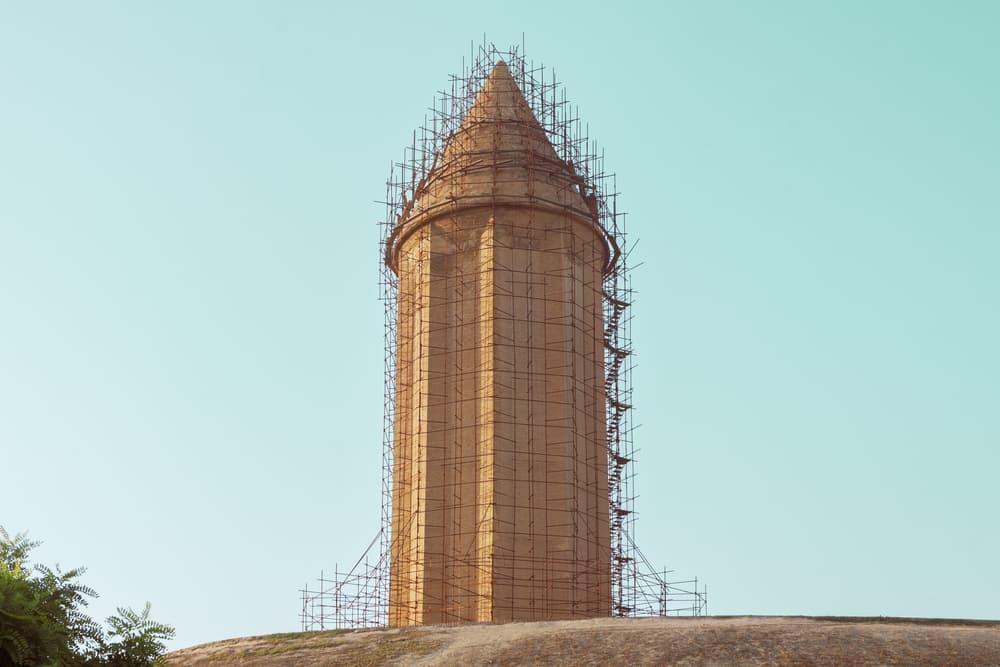
In northeastern Iran, across the Golestan Plain, a brick tower rises over 50 metres without a hint of unnecessary ornament. Built in 1006–1007 CE, the Gonbad-e Qabus Tower is the mausoleum of the Ziyarid prince Qabus ibn Wushmgir. Inscribed as a UNESCO World Heritage site in 2012, it is regarded as one of the purest examples of medieval Islamic funerary architecture.
Quick Reference Guide
- Access: Gonbad-e Kavus city centre, visible from most neighbourhoods
- Recommended duration: 1 to 2 hours on site
- Dress code: Smart casual recommended; headscarf mandatory for women
- Admission: Paid (UNESCO-inscribed site)
What You'll See
The tower presents itself as a cylinder of fired brick with ten prominent vertical ribs, crowned by a conical roof. It rises over 50 metres, making it one of the tallest brick towers of the medieval world. Two Kufic inscriptions run as friezes—one at the base, the other beneath the roof—indicating the construction date and the patron's name.
The interior is austere: a single circular chamber, unadorned. The structural mastery lies in the geometry itself—bricks assembled with remarkable precision to withstand earthquakes and the passage of centuries.
History and Context
Qabus ibn Wushmgir (c. 949–1012) was a learned prince of the Ziyarid dynasty and patron of scholars; the court of Avicenna was among those he frequented. He commissioned this tower during his lifetime as a funerary monument. Local legend holds that his coffin was suspended within the upper cupola, bathed in light by carefully oriented apertures.
The tower survived Mongol and Seljuk invasions, testament to the strength of its construction. It lent its name to the city that grew at its feet over the centuries.
Highlights of Your Visit
The Silhouette Across the Plain
The approach from the road is striking: the tower rises alone across a flat landscape, unrivalled in its prominence. Late afternoon light gilds the brick and accentuates the vertical ribs. Take time to circle the base and appreciate the play of shadows.
The Kufic Inscriptions
The two epigraphic friezes are exceptionally legible for their age. They constitute a primary historical document: date, the prince's name, statements of faith. A local guide can decipher their content on site.
The Surrounding Park
The tower is set within landscaped green space, frequented by local families in the early evening. This contrast between a thousand-year-old monument and contemporary Iranian daily life is an experience in itself.
Etiquette and Visiting Rules
- Headscarf mandatory for women at the site.
- Do not touch the inscriptions or brick walls.
- Respect the marked areas around the base.
Photography Tips
Golden late-afternoon light is ideal for bringing out the texture of the brick and the prominence of the ribs. A wide-angle lens allows you to frame the entire tower from ground level. For the inscriptions, raking morning light reveals the relief of the Kufic letters. Drones require authorisation in Iran: check with your local agency before any flight.
Location and Access
The tower stands in the heart of Gonbad-e Kavus, the capital of Golestan Province, in northeastern Iran. The city is accessible from Gorgan, the provincial capital, by road. Gorgan has a railway station and an airport with connections to Tehran. From Gorgan, shared taxis and buses regularly serve Gonbad-e Kavus.
The tower is visible from the city centre and easily reached on foot from local hotels. Wheelchair access to the external site is feasible; the interior of the tower may have steps.
Nearby Sites
- Old Town of Gorgan — traditional bazaars and Qajar architecture less than an hour's drive away.
- Hyrcanian Forests of Golestan — a UNESCO-inscribed relict forest, lush mountain landscape at the province's edge.
- Golestan National Park — one of Iran's oldest protected areas, remarkable fauna and flora.
- Great Wall of Gorgan — Sassanid fortification stretching hundreds of kilometres, an overlooked vestige of Iranian antiquity.
Frequently asked questions
Spring (April–May) and autumn (September–October) offer pleasant temperatures on the Golestan Plain. Summer can be hot and humid; winter remains mild but rainy in this region near the Caspian Sea.
Smart casual dress is expected. Women must wear a headscarf. Although not an active place of worship, Iranian dress codes apply at all public sites.
Access to the tower's interior is generally possible but limited. The inner chamber is austere, and most of the architectural interest is perceived from the outside. Check on-site conditions for current access.
One day suffices for the tower itself. Combine with the Great Wall of Gorgan and Golestan National Park for a two- to three-day circuit through the province. Gorgan serves as a logical base.
Photography is allowed at the external site. Inside, respect any instructions from the site guardian. Drones require specific authorisation from Iranian authorities.
One to two hours allow for a complete circuit of the monument, reading the inscriptions, and enjoying the surrounding park. Add time if you wish to explore Gonbad-e Kavus town centre.
Interested in this visit?
We can include it in your personalised itinerary.