Iran Carpet Museum (Tehran Carpet Museum)
Iran Carpet Museum (Tehran Carpet Museum)
Located in Laleh Park in central Tehran, the Iran Carpet Museum houses centuries of Persian textile production: Safavid court carpets, nomadic kilims and Qom silks, within a building shaped like an unrolled carpet.
The Iran Carpet Museum, situated in Laleh Park at the heart of Tehran, holds one of the world's largest collections of Persian carpets. Founded under the Pahlavi dynasty, it brings together pieces woven over many centuries, representing all regions of the country. The building itself—designed to evoke a partially rolled carpet—is an architectural statement in its own right. It stands as an essential reference for understanding Iranian textile craftsmanship in its full historical and regional depth.
Practical information at a glance
- Access: Laleh Park, North Kargar Avenue, Tehran — accessible by metro (Doktor Hessabi station, line 2)
- Recommended duration: 1.5 to 2 hours for a complete visit
- Dress code: Smart casual required; women must wear a headscarf indoors
- Accessibility: Level entrance, easy access to ground floor
What to see
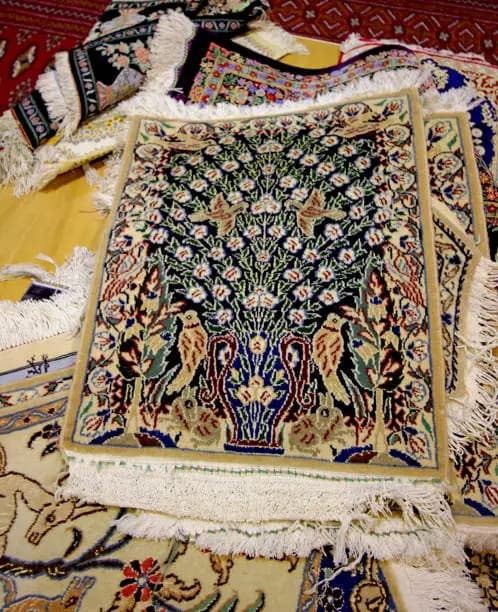
The museum displays carpets and kilims spanning several centuries of production, from the 16th century to the present day. The pieces are organized by region of origin: Tabriz, Isfahan, Kashan, Kerman, Qom, as well as productions from the Qashqai and Bakhtiari nomadic tribes. Each carpet is accompanied by information on its knotting techniques, materials (wool, silk, cotton) and characteristic motifs.
A section is dedicated to traditional weaving tools and looms, allowing visitors to visualize the manufacturing process. Some of the exhibited pieces contain several hundred knots per square centimetre, bearing witness to craftsmanship of extraordinary precision.
History and context
The museum was inaugurated in 1978, shortly before the Islamic Revolution, on the initiative of Farah Diba, wife of Shah Mohammad Reza Pahlavi. The building was designed by Iranian architect Ali Sardar Afkhami. The Persian carpet, inscribed on UNESCO's Intangible Cultural Heritage list, is far more than a decorative object: it constitutes a coded visual language, carrying cosmological, floral and geometric symbols particular to each region and era.
Following the 1979 revolution, the museum continued its operations under the Ministry of Culture, progressively enriching its collections.
Highlights of the visit
Safavid court carpets
Pieces dating from the Safavid era (16th-17th centuries) are among the most impressive. Their symmetrical floral compositions and deep colourways—achieved with vegetable dyes—illustrate the zenith of court production in Isfahan and Kashan.
Nomadic kilims
The kilims of the Qashqai and Bakhtiari tribes offer a striking contrast to court carpets. Geometric, vibrant, woven without knots, they reflect an autonomous nomadic aesthetic, passed down orally through generations.
Qom silk carpets
Qom's pure silk productions rank among the finest technically. Their knot density and the distinctive luminosity of silk give them an almost pictorial quality, bordering on textile miniature.
Building architecture
The exterior façade, which mimics the shape of a partially rolled carpet, deserves attention before even stepping inside. This architectural gesture, rare in the Iranian museum context, anchors the building in its purpose from the outset.
Photography tips
Natural light filtered through the large windows is favourable mid-morning. Photograph carpets from a slight overhead angle to capture the depth of the patterns. Some rooms may be dimly lit: a higher ISO setting is useful. Check with staff whether photography is permitted in all galleries—rules may vary depending on temporary exhibitions.
Location and access
The museum is located in Laleh Park, one of central Tehran's major green spaces, close to Tehran University. Doktor Hessabi metro station (line 2) provides direct access without a car. The park itself invites exploration before or after your visit.
Within a few minutes' walk are the Iran Archaeological Museum and the Tehran Museum of Contemporary Art, allowing you to combine several cultural visits in a single half-day.
Nearby attractions
- Tehran Museum of Contemporary Art — major collection of Western and Iranian modern art, a few minutes' walk away in Laleh Park.
- Iran Archaeological Museum — traces Iran's history from prehistory through the Islamic period, essential for contextualizing Persian civilization.
- Saadabad Complex — former royal residence in northern Tehran, housing several museums within a wooded setting.
- Tehran Grand Bazaar — to observe and purchase carpets in their traditional commercial setting, a few kilometres south.
Frequently asked questions
The museum is open year-round. Spring (March-May) and autumn (September-November) offer pleasant weather in Tehran for combining a visit with a stroll through Laleh Park.
Yes. As in any public place in Iran, women must wear a headscarf and clothing that covers the arms and legs. Men should avoid shorts and overly casual attire.
Yes. The Tehran Museum of Contemporary Art and the Iran Archaeological Museum are within walking distance of Laleh Park. A full day allows you to visit all three.
Photography is generally tolerated for personal use, but it is advisable to check on site, particularly for temporary exhibitions where restrictions may apply.
Allow between 1.5 and 2 hours to explore the collections mindfully. Textile and craftsmanship enthusiasts can easily spend considerably longer.
Yes. Doktor Hessabi station on line 2 is the nearest metro stop. This is the most convenient way to avoid central Tehran traffic.
Interested in this visit?
We can include it in your personalised itinerary.