Fin Garden
Fin Garden
Inscribed on the UNESCO World Heritage list in 2011, the Fin Garden in Kashan exemplifies the art of Persian gardens, with Safavid pavilions, qanats and the legacy of Chancellor Amir Kabir.
The Fin Garden (Bagh-e Fin) is located in the southern part of Kashan, on the edge of a village that gave it its name. Inscribed on the UNESCO World Heritage list in 2011, it represents one of the finest examples of Persian garden design, shaped by Safavid rulers and later enriched by succeeding dynasties.
Why visit the Fin Garden
This walled garden illustrates an ancient concept: transforming the desert into an image of paradise through the mastery of water. Towering cypresses, pines, pomegranate trees, cascading pools and fountains fed by the Soleymanieh spring compose an ensemble that has changed little since the time of Shah Abbas I. Beyond the botanical setting, the site houses several royal pavilions, historic hammams and Kashan's national museum, making it an experience that is architectural, botanical and cultural all at once.
Its inscription on the UNESCO World Heritage list in 2011 recognized the Fin Garden as an archetype, comparable to the Dowlat Abad Garden in Yazd. It is one of the rare Persian gardens to have preserved its original layout, functioning qanats and decorated pavilions.
The history of the Fin Garden
The site was founded in the first decade of the 16th century, under the Safavid dynasty. An initial design was laid out in 1504 on the orders of Shah Ismail I, who wished to establish a residence in the village of Fin, fed by the Soleymanieh spring. The current layout is the work of Shah Abbas I the Great, who redesigned it to make it one of the court's favored residences. Succeeding sovereigns — Shah Safi I, Shah Soleyman I, then Karim Khan Zand and Fath Ali Shah Qajar — stayed here and restored the buildings.
The site remains associated with the memory of Chancellor Amir Kabir. An ambitious reformer under Nasseredin Shah, he drew the hostility of the court. At the request of the queen mother, he was executed in the garden's hammam on January 10, 1852. A plaque today commemorates this political tragedy at the heart of the baths.
The garden was inscribed on the UNESCO World Heritage list in 2011, as part of a collection of nine representative Persian gardens.
What to see on site
The garden and its hydraulic system
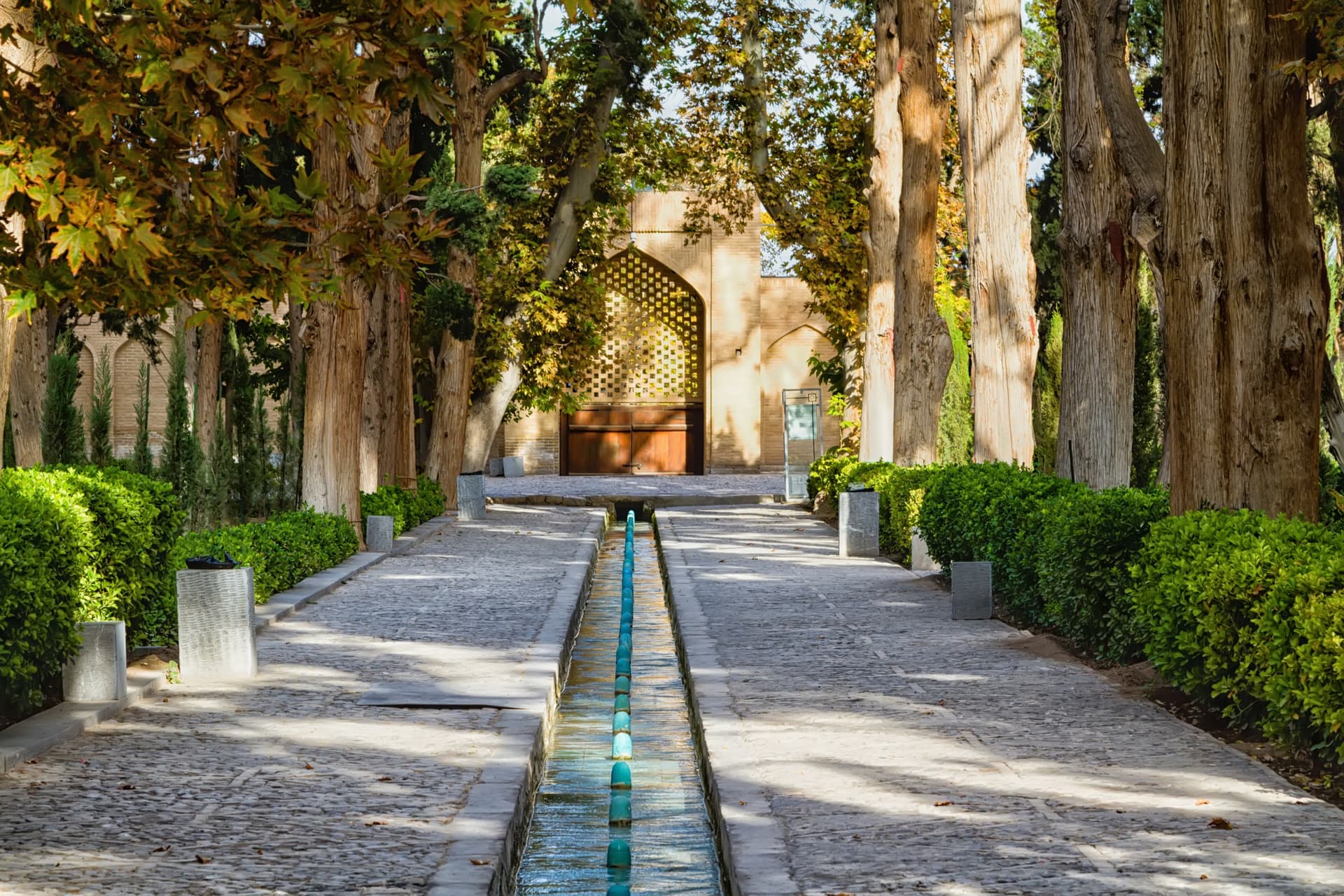
The fortified enclosure, flanked by circular towers, encloses dense vegetation of cypresses, pines and pomegranate trees. Turquoise-bottomed channels distribute water from the Soleymanieh spring through a succession of pools and fountains. The water supply system relies on qanats, those underground galleries characteristic of Iranian engineering.
The vestibule and the hashti
The main entrance opens to the northwest. The hashti, an octagonal entry hall, features sculpted ceilings and arcades opening onto the garden. To the left and right of the main door, two small side openings were cut through to allow animals to pass.
The central pavilion Shotor Galu
At the heart of the garden stands the Shah Abbasi Shotor Galu pavilion, a two-story structure. The rammed earth walls are covered in ceramic tiles, the floor is laid with marble, and a central pool fed by the qanats runs through the hall. The wall frescoes are attributed to the time of Fath Ali Shah Qajar (early 19th century) and depict the sovereign surrounded by courtiers.
The Fath Ali Shah pavilion
Built in 1811, this pavilion is of later construction. The ceiling frescoes have largely disappeared, but the vaults, colonnades and stucco inscriptions still testify to the refinement of Qajar decoration.
The royal baths
The garden's hammam distinguishes the basins reserved for the shahs from those for servants. It was here that Chancellor Amir Kabir was executed in 1852, making it a place charged with history as much as an example of Persian thermal architecture.
Kashan's national museum
Set up in the western wing and inaugurated in 1958, the museum features two sections. The archaeological section brings together artifacts from the sites of Hasanlu, Sialk and Lorestan, spanning several millennia of occupation on the Iranian plateau. The ethnographic section focuses on Qajar calligraphy, with manuscripts and scribal tools.
Practical information
- Visit duration: allow 1.5 to 2.5 hours for the garden, pavilions and museum.
- Opening hours: open daily, generally with continuous daytime hours. Hours vary by season.
- Admission: paid entry, moderate rate for foreign visitors. An additional fee is charged for the museum.
- Tip: bring water; there are few shaded areas outside the vegetation in the middle of the day.
When to visit
Kashan sits on the edge of the desert and experiences significant temperature swings. The best times are spring (April-May), when fruit trees bloom and temperatures remain mild, and autumn (October-November). Summer is very hot, with temperatures regularly exceeding 104°F at midday: consider visiting early morning or late afternoon. Winter is manageable but nights are cold.
The Kashan region is also famous for its rose water festival in late spring, a time when visitor numbers swell.
In the vicinity
The Fin Garden can easily be visited as part of a day in Kashan. Several major sites are nearby in the old city:
- The traditional Boroudjerdi residence, an emblematic Qajar merchant house.
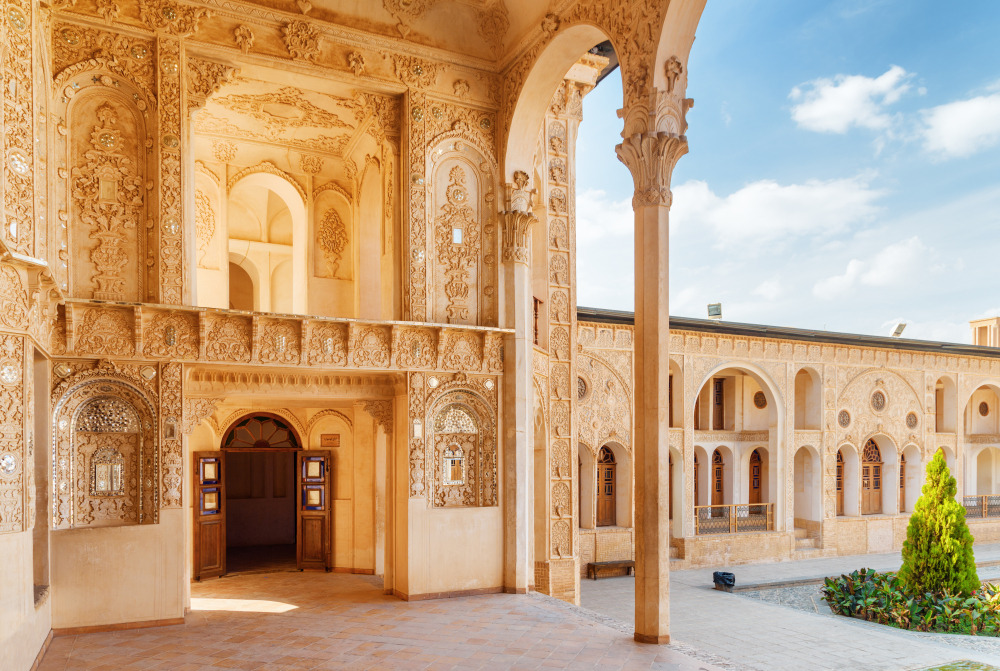
- The Tabatabaei house, another example of Kashan's domestic architecture.
- The Sultan Amir Ahmad hammam, famous for its turquoise vaults.
- The Agha Bozorg mosque and madrasa, with its understated dome.
- The troglodyte village of Abyaneh, about 50 miles away, accessible as a half-day excursion.
Getting there
The garden is located about 5.5 miles southwest of central Kashan, on Amir Kabir Boulevard. Several options are available:
- By taxi from downtown: a twenty-minute journey, the simplest option.
- By shared taxi (savari) from major streets: cheaper, but requires basic Farsi.
- By car: parking available near the entrance.
Kashan itself is connected by train and bus to Tehran (about 3 hours) and Isfahan (about 2.5 hours), making it easy to include the Fin Garden in a central Iran itinerary.
Frequently asked questions
Frequently asked questions
Yes. It was inscribed on the World Heritage list in 2011 as part of a collection of nine representative Persian gardens.
Allow 1.5 to 2.5 hours to explore the garden, visit the pavilions and Kashan's national museum located on the site.
Chancellor Amir Kabir, a reformer under Nasseredin Shah, was executed there on January 10, 1852, at the request of the queen mother. The hammam is today a memorial place open to visitors.
Spring (April-May) and autumn (October-November) offer the most pleasant conditions. Summer is very hot; winter is manageable but cool at night.
Yes. The Boroudjerdi house, the Tabatabaei house, the Sultan Amir Ahmad hammam and the Agha Bozorg mosque can all be visited in the same day. The village of Abyaneh is accessible as an excursion from Kashan.
Extend your journey
The Fin Garden naturally fits into a central Iran circuit connecting Tehran, Kashan, Isfahan and Yazd. To plan a tailor-made itinerary integrating UNESCO sites and desert oasis towns, explore our Iran travel suggestions.
Interested in this visit?
We can include it in your personalised itinerary.