Boroudjerdi House: A Traditional Kashan Residence
Boroudjerdi House: A Traditional Kashan Residence
Built between 1839 and 1857 for a wealthy Kashan merchant, the Boroudjerdi House exemplifies the pinnacle of Qajar domestic architecture.
In Kashan, in Isfahan Province, the Boroudjerdi residence (Khaneh-yé Boroudjerdi) stands as a testament to the splendor of Iran's merchant upper class during the 19th century. With its wind towers, murals, and carefully proportioned courtyards, it ranks among the finest examples of Qajar domestic architecture.
Why Visit the Boroudjerdi House
The mansion bears witness to Kashan's commercial prosperity during the Qajar era, when carpet, silk, and rose water merchants accumulated fortunes rivaling those of the nobility. The building brings together three rare features within a single private residence: a sophisticated passive ventilation system (the badguirs), decorative paintings by the greatest court artist, and a perfectly preserved traditional spatial layout. Located within the bazaar, it can be visited in less than two hours and naturally fits into a walking tour of the city's major historic mansions.
History: A Wedding Gift from 18 Years of Construction
The house was commissioned by Haji Mehdi Boroudjerdi, a wealthy Kashan merchant, to mark his marriage to a descendant of the Tabatabaei family, whose own mansion stood just steps away. According to some sources, building a residence comparable in status to the Tabatabaei House was even set as a condition for the union.
The architect chosen was Ustad Ali Maryam, one of the region's most renowned master builders. Construction began in 1839 and engaged approximately 150 workers for 18 years, concluding in 1857. The scale and duration of the project, exceptional for a private commission, reflect both the financial solidity of its patron and the complexity of techniques employed: carved stucco, mirror work, murals, and the orchestration of light within vaulted spaces.
What to See On Site
The Wind Towers (Badguirs)
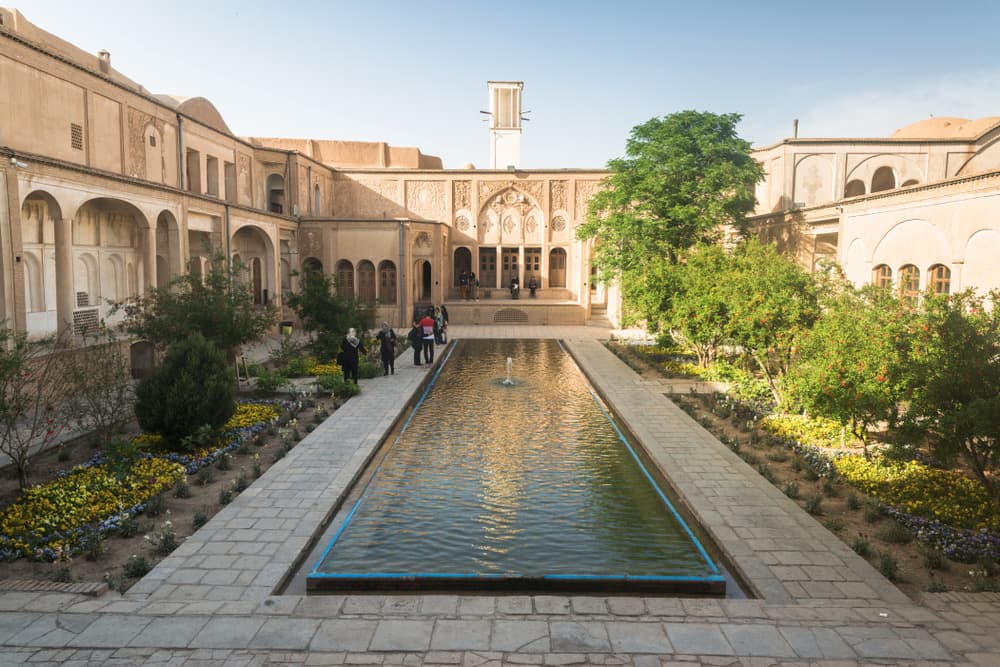
Three badguirs rise from the roofline approximately 3 meters above the mansion's upper level. One takes the form of a six-sided dome pierced with six windows, which capture air currents and direct them toward the grand reception hall. The system connects to an interior pool: hot air, cooled by contact with water, emerges refreshed into the main rooms. This passive climate architecture, typical of cities on the Iranian plateau, operates without any mechanical assistance.
The Biruni / Andaruni Organization
As in all traditional mansions of the elite, space divides into two: the biruni, the public section reserved for receiving men, and the andaruni, the private realm where the family, particularly women, lived. Only the biruni is open to visitors; from its courtyard, however, one can glimpse the facades of the andaruni, which remain off-limits. The house features three entrance doors, whose placement reflects this separation of circulation.
Kamal-ol-Molk Paintings and Stuccowork
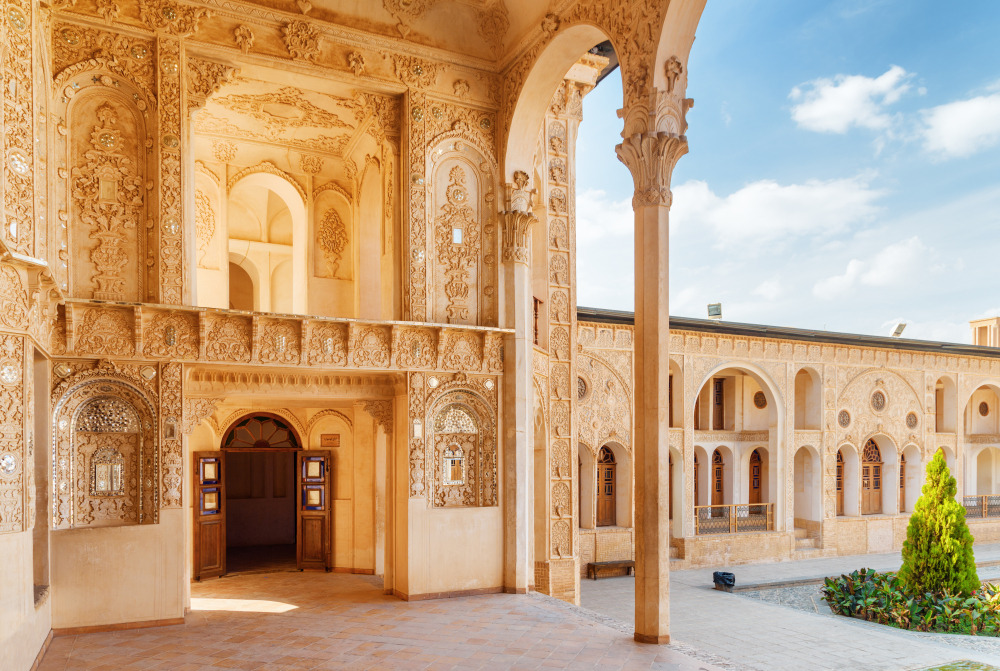
The grand reception hall preserves murals attributed to Kamal-ol-Molk, the official Qajar court painter. Some have been weathered by time; others remain vivid. The stucco displays a figurative repertoire rare in Islamic architecture: peacocks, pheasants, flamingos, and local plants mingle with traditional geometric motifs, beneath domes adorned with mirror fragments and colored glass.
Practical Information
- Location: within Kashan's historic quarter, inside the bazaar perimeter.
- Access by car: head to the intersection of Alavi Street and Fazel Naraqi Street; parking available in immediate vicinity.
- Hours: open daily during daytime; verify locally, as hours vary by season.
- Admission: modest paid entry, collected by the Iranian cultural heritage authority.
- Duration of visit: plan for 45 minutes to 1.5 hours depending on interest in the décor.
When to Go
Kashan has a continental climate. Summer, from April to September, is warm to very hot, with uncomfortable daytime temperatures. Winter, from November to February, is dry and cold, with lows approaching 0°C in January. The most pleasant seasons for visiting the house and exploring the bazaar are the shoulder months: March, April, and October. The blooming of Damask roses around Kashan in May adds further appeal to the journey.
How to Get There
Kashan is accessible from Tehran by train (approximately 2 to 3 hours from the central station) or long-distance bus. The city is also a standard stop on the Tehran–Isfahan route. Once in Kashan, the Boroudjerdi House lies in the sector of major historic mansions, reachable on foot from most city center hotels. The neighborhood lends itself to walking: pedestrian alleyways, earthen-colored facades, and covered bazaar passages.
Nearby Attractions
- Tabatabaei House: 4,700 m² and around forty rooms, a few minutes' walk away.
- Ameri House: another great merchant mansion, now partly repurposed.
- Agha Bozorg Mosque: a major religious structure in Kashan, remarkable for its sunken courtyard.
- Kashan Bazaar: covered and lively, closed on Thursdays and Fridays.
- Toy Museum: in the immediate vicinity of the historic houses.
- Fin Garden: UNESCO-listed Persian garden on the outskirts of Kashan.
- Abyaneh: red-earth village approximately 80 km away, accessible as a day excursion.
FAQ
Frequently asked questions
Plan for an average of 45 minutes to 1.5 hours. A combined visit with the neighboring Tabatabaei House requires half a day.
No. Only the biruni, the public section of the house, is open to visitors. The facade of the andaruni remains visible from the main courtyard, however.
They are attributed to Kamal-ol-Molk, the official Qajar court painter and a major figure in 19th-century Iranian painting.
The two mansions are connected by marriage and feature comparable systems. The Tabatabaei House is larger (4,700 m², around forty rooms); the Boroudjerdi House is more compact but preserves particularly refined painted décor.
The shoulder months, mainly March, April, and October, offer the most pleasant temperatures. May corresponds to the blooming of roses in the region.
Planning Your Visit
The Boroudjerdi House naturally integrates into a cultural itinerary in Iran combining Tehran, Kashan, Isfahan, and Yazd. To build a tailor-made journey featuring great Qajar mansions and traditional desert villages, explore our Iran trips.
Interested in this visit?
We can include it in your personalised itinerary.