Ice Houses
Ice Houses
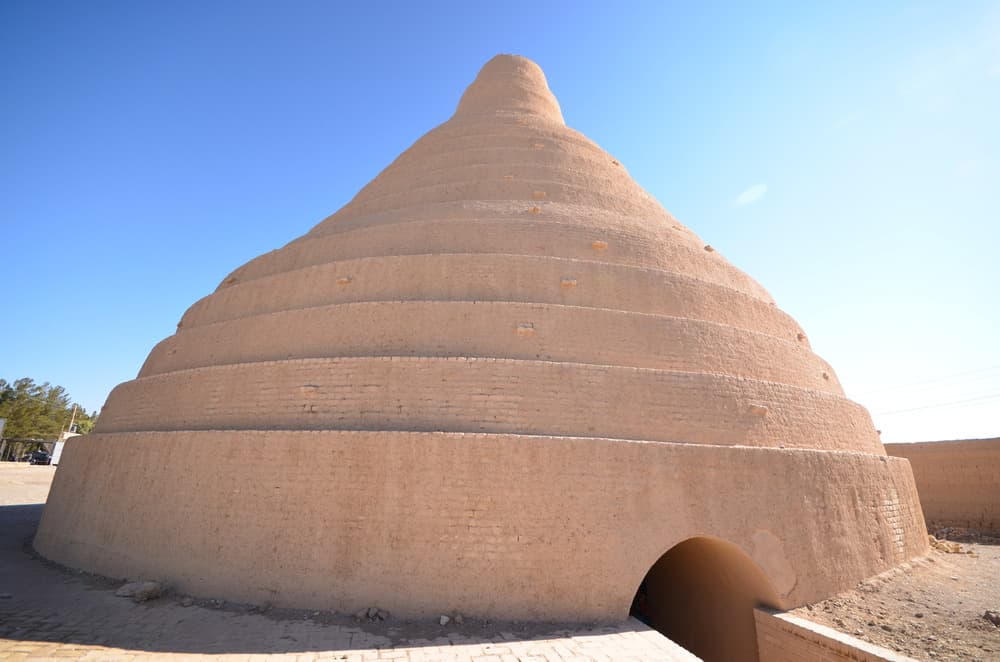
The yakhtchal ice houses of Abarkuh, conical structures inherited from the Qajar dynasty, demonstrate ancient engineering capable of preserving ice in the heart of the Iranian desert.
Some 155 km southwest of Yazd, the small town of Abarkuh preserves a remarkable collection of ice houses — known as yakhtchal in Persian. These conical semi-subterranean structures, inherited chiefly from the Qajar dynasty, bear witness to ancient engineering capable of storing ice in the heart of the Iranian desert.
Why Visit Abarkuh's Ice Houses
The yakhtchal of Abarkuh rank among the best-preserved examples of pre-industrial refrigeration architecture in the Middle East. Unlike mosques and palaces that often dominate Iranian itineraries, these buildings served a practical function: preserving ice produced in winter for the royal court and local notables throughout the summer heat. Their pyramidal silhouette, visible from afar, has become part of the town's landscape.
The appeal of a visit lies as much in the architecture as in the technical principle: a system combining water management, controlled sun exposure, and insulation through the thickness of raw brick walls.
History and Context
Abarkuh — also spelled Abarkouh or Abarkū — is the principal city of the county of the same name in Yazd Province. While the city's origins remain poorly documented, the ice houses visible today date chiefly from the Qajar dynasty (nineteenth century).
They served to store ice intended for supplying cold drinks and food preservation for the court and local elite. With the arrival of modern refrigeration in the twentieth century, these installations lost their purpose. Several have been restored and now rank among the region's protected heritage elements.
How a Yakhtchal Works
The yakhtchal rests on a simple principle, refined in its execution:
- Semi-subterranean structure in the form of a pyramid or dome, wider at the base and narrowed toward the top, which limits sun exposure and promotes the escape of hot air.
- Thick raw brick walls mixed with traditional mortar (often a sarooj, an insulating blend), which preserve interior coolness.
- Storage wells that can reach more than 20 metres in depth, with some installations boasting a useful volume of around 5,000 m³.
- Water channelled from mountain peaks via canals, then frozen in winter in shallow basins before being broken up and stored.
Once the ice was stored, the thickness of the walls and minimal heat input allowed it to be preserved for several months, until the height of summer.
The Main Ice Houses to See
Barzan Icehouse
The most imposing of the group, standing at approximately 20 metres high. Its slender silhouette makes it a visual landmark in the town and a good starting point for understanding the scale of these structures.
Aghazadeh Icehouse
Pyramidal in form, designed to cast a shadow over the water jar positioned nearby. In winter, the water in the jar would freeze, and the ice thus formed would be transferred inside the structure. It is one of the most photographed in the town.
Hak Icehouse
More modest in dimensions than the two preceding examples, it illustrates the application of the same architectural principle on a smaller scale.
Maryam Abad Icehouse
Another testament to the Qajar era, this ice house operated on the same principle of a natural refrigerator and rounds out the circuit of Abarkuh's yakhtchal nicely.
What to See Nearby
A few minutes from the town centre, the Zoroastrian Cypress stands over 25 metres tall and is believed to be more than 4,500 years old, making it one of the oldest known trees in Asia. This tree, venerated in the Zoroastrian tradition, warrants a brief but essential detour during your visit.
To extend your itinerary, several Iranian sites offer further discovery of the region's heritage: the historic village of Abyaneh, the Fin Garden in Kashan, or the Mausoleum of Ali Ebn-e Hamzeh in Shiraz.
When to Visit
Abarkuh experiences a desert climate. Rainfall, scarce, concentrates between February and April with fewer than 12 mm per month. Summer is very hot: in August, temperatures can reach 39 °C, making a visit uncomfortable.
The most recommended period extends from October through December: milder temperatures, clear skies, and better light for photographing the conical structures.
How to Get There
- From Tehran: long-distance bus to Abarkuh, covering a route of approximately 740 km. Allow a full day of travel.
- By air: Abarkuh has no civil airport. The simplest option is to fly to Yazd on a domestic flight, then continue by private taxi or car.
- From Yazd: approximately 155 km by road, accessible by private taxi or organised tour.
On the ground, visiting the main ice houses is easily done on foot or by local taxi. Allow 2 to 3 hours to explore the major sites, longer if you include the Zoroastrian Cypress.
Frequently Asked Questions
Frequently asked questions
A yakhtchal (literally "ice pit" in Persian) is a traditional Iranian semi-subterranean structure, dome- or pyramid-shaped, designed to store ice in the middle of the desert. The principle combines insulation through thick walls, shade cast by the structure, and a deep well.
Several yakhtchal are visible in and around the town, among the most well-known being Barzan, Aghazadeh, Hak, and Maryam Abad. All date chiefly from the Qajar dynasty.
It is not mandatory, but an English-speaking local guide offers useful insight into the technical operation and historical context. Several agencies offer excursions from Yazd.
Yes. Abarkuh is often included as a stop between Yazd and Shiraz, allowing you to visit the ice houses and the Zoroastrian Cypress within the same day.
October through December: moderate temperatures, low probability of rain, and favourable light for photography.
Planning Your Trip
The ice houses of Abarkuh fit naturally into an itinerary linking Yazd, Shiraz, and Isfahan. To build a bespoke itinerary including these heritage sites, consult our Iran tours.
Interested in this visit?
We can include it in your personalised itinerary.