Jameh Mosque in Isfahan
Jameh Mosque in Isfahan
Inscribed on the UNESCO World Heritage List in 2012, Isfahan's Jameh Mosque unfolds a four-iwan plan and domes that trace over a thousand years of Iranian architecture.
Located in the historic center of Isfahan, the Jameh Mosque, also known as the Friday Mosque or Great Mosque of Isfahan, is Iran's oldest Friday Mosque. Founded as early as the 10th century and reworked for over a millennium by the dynasties that succeeded one another on the Iranian plateau, it stands as a manual of Islamic architecture in its own right. Inscribed on the UNESCO World Heritage List in 2012, it remains an active place of prayer.
Why visit the Jameh Mosque
Compared to the two other great mosques of Isfahan—the Sheikh Lotfollah Mosque and the Imam Mosque (or Shah Mosque)—the Jameh Mosque impresses less through the brilliance of its decoration than through its historical depth. Each iwan, each dome, each hypostyle hall corresponds to a different dynasty. UNESCO describes it as an "exceptional example of innovation in the adaptation and application of architectural technology."
It is also a key reference for understanding the so-called "four-iwan" plan, which subsequently became established throughout the Iranian world and beyond. For those interested in the history of Islamic art, a visit is a logical step before or after exploring Naghsh-e Jahan Square.
History: twelve centuries of architectural layers
Before the mosque stood, according to medieval sources, a Zoroastrian temple from the Sassanid era. After the Arab conquest of Isfahan in the mid-7th century, the site was converted into a Muslim place of worship, then replaced by a more ambitious structure under the Umayyads.
The classical four-iwan plan was introduced in the 9th century by the Seljuk sultans, who also equipped the mosque with two monumental domes. Chronicles recount a famous rivalry during the reign of Malik Shah I: the vizier Taj-al-Muluk had a second dome erected to surpass the one commissioned by his rival Nizam al-Mulk. This episode fixed the building's distinctive character and remains one of the most frequently cited anecdotes by local guides.
The Seljuks were succeeded by the Mongols, the Ilkhanids, the Timurids, the Safavids, and finally the Qajars. Each added a hall, a mihrab, a mosaic, or a dome, making the Jameh Mosque a continuous witness to the evolution of Iranian religious architecture. Registered as an Iranian national monument in 1932, it joined UNESCO's World Heritage List in 2012.
What to see inside
The enclosure is organized around a vast courtyard with four iwans, complete with a central ablution fountain used for purification rites. Four ensembles deserve particular attention.
The southern iwan and the Seljuk hypostyle hall
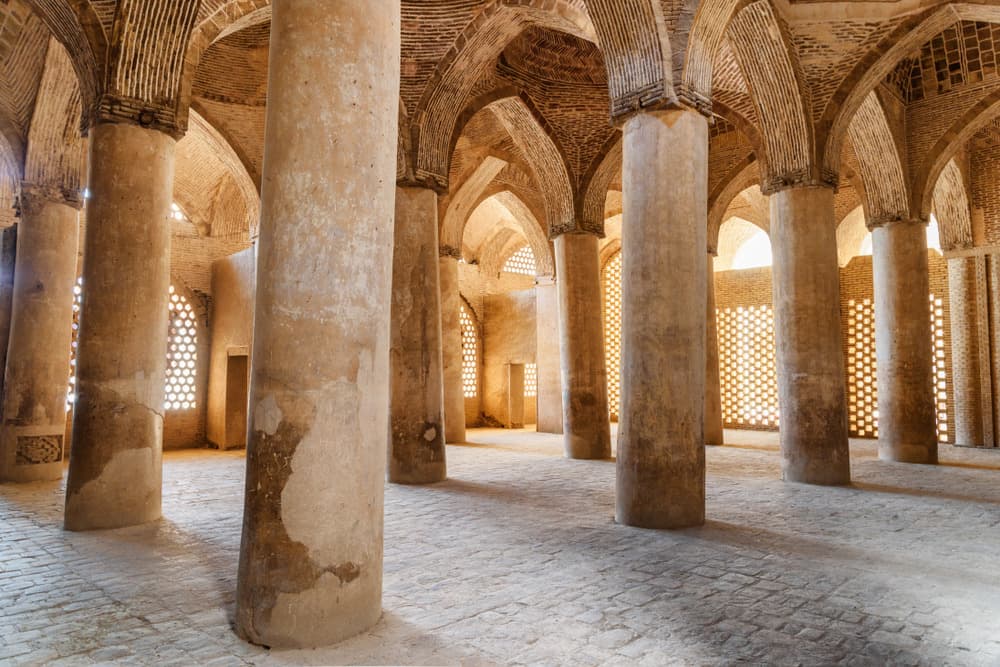
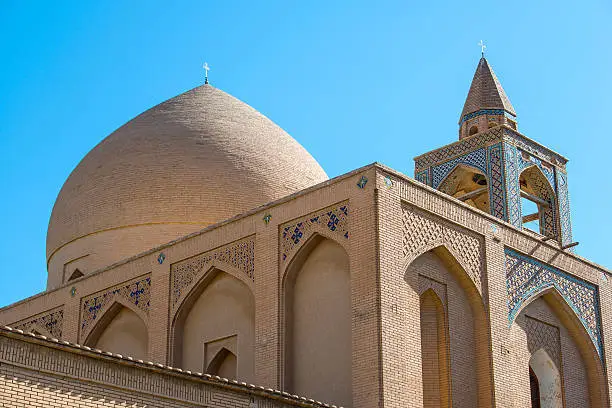
The southern iwan, crowned with two minarets, concentrates several periods on a single facade. The stalactite finish is of Mongol origin, while the enameled ceramics framing the minarets are attributed to the Timurids (1405–1507). Inside, the Seljuk hypostyle hall lines up modest brick pillars and three domes decorated with geometric motifs arranged around a central opening.
The Taj-al-Muluk dome
Behind the northern iwan rises the Taj-al-Muluk dome, considered by art historians as one of the pinnacles of brick construction in Iran. Its refined geometry contrasts with the colorful coverings of later periods.
The Uldjaitu prayer hall
Dating to the early 14th century, this Ilkhanid-era hall houses a stucco-carved mihrab renowned for the delicacy of its floral and calligraphic motifs. It is accessed from the western iwan.
The western iwan and Safavid contribution
The western iwan combines a Seljuk structure with a mosaic facing applied during the Safavid period. The interplay of mirrors and colored ceramics recalls the decorative vocabulary of the great mosques of Isfahan visible on Naghsh-e Jahan Square.
A guided tour is recommended to distinguish the contributions of each dynasty: without a reference point, reading the layers requires some background in art history.
Practical information
- Visit duration: allow 1 to 2 hours to tour the main halls.
- Admission: entry fee at a moderate rate for foreign visitors (payable in Iranian rials; bring cash).
- Hours: open daily in morning and afternoon, with closure during Friday midday prayer.
- Dress code: modest dress required; headscarf for women, long pants and covered sleeves for all.
- Non-Muslim access: permitted outside prayer times.
When to visit
Isfahan is pleasantly visited in spring (March to May) and autumn (September to November), when temperatures remain moderate. Summer is very hot and dry; winter is cool with occasional snow. For the Jameh Mosque, avoid Friday midday prayer, when tourist visits are suspended. Late afternoon light particularly accentuates the bricks of the northern dome.
How to get there
The mosque is located in Isfahan's historic center, in the grand bazaar district. From Naghsh-e Jahan Square, it can be reached on foot by crossing the bazaar along Majlesi Street in about twenty minutes. By taxi, the journey is short from any point in the center.
Nearby attractions
- Isfahan's Grand Bazaar, adjacent to the mosque.
- Naghsh-e Jahan Square, which brings together the Sheikh Lotfollah Mosque, the Imam Mosque, and the Ali Qapu Palace.
- The Isfahan Natural History Museum and the Isfahan Contemporary Art Museum.
To extend your exploration of the region, several sites are worth a detour from Isfahan: the ochre village of Abyaneh, the Fin Garden in Kashan, or the Ghoortan Citadel.
Frequently asked questions
Frequently asked questions
One to two hours are sufficient to tour the courtyard, the four iwans, the domes, and the Uldjaitu prayer hall. Allow more time if you are accompanied by a guide who details the contributions of each dynasty.
Yes, the mosque is open to all visitors outside of prayer times. Friday midday prayer remains reserved for the faithful.
As in all Iranian places of worship, modest dress is required. Women must wear a headscarf over their hair and a top covering the arms; men should avoid shorts.
Yes, the interest is complementary. Naghsh-e Jahan illustrates the Safavid apogee, while the Jameh Mosque showcases the long maturation of Iranian architecture over nearly a millennium, with Seljuk, Ilkhanid, and Timurid elements found nowhere else.
Plan your trip
The Jameh Mosque naturally integrates into a cultural itinerary around Isfahan and the great cities of Iran's central axis. To build a tailor-made itinerary, consult our journeys in Iran.
Interested in this visit?
We can include it in your personalised itinerary.