Qeshm Island
Iran's largest island, in the Strait of Hormuz, brings together salt canyons, protected mangrove forests and villages with traditional windtowers. A natural and cultural destination in its own right.
Qeshm is Iran's largest island, positioned in the Strait of Hormuz between the mainland and the United Arab Emirates. Designated a free trade zone, it draws visitors equally for its spectacular geological landscapes — salt valleys, mangrove forests, ochre cliffs — and its distinctive bandar culture, heir to centuries of maritime exchange between Persia, Africa and the Indian subcontinent.
Practical information at a glance
- Access: direct flights from Tehran, Shiraz and other Iranian cities to Qeshm Airport; ferry from Bandar Abbas (short crossing).
- Free trade zone: citizens of many countries can enter without an Iranian visa for a limited stay — verify current conditions with your agency.
- Dress code: Iranian dress codes in effect (headscarf for women, long sleeves).
- Recommended duration: 2 to 3 days to cover the main natural sites.
- Best time to visit: October to April, before the humid Gulf summer heat.
What to see
The island concentrates rare geological formations. The Valley of the Stars (Chahkooh) is a canyon carved by erosion through salt and clay, with walls striped in red and ochre. The Hara mangrove forest covers a vast protected coastal area, a refuge for migratory birds and dolphins. The Kharbas caves, carved into rock by pre-Islamic inhabitants, overlook the sea.
History and context
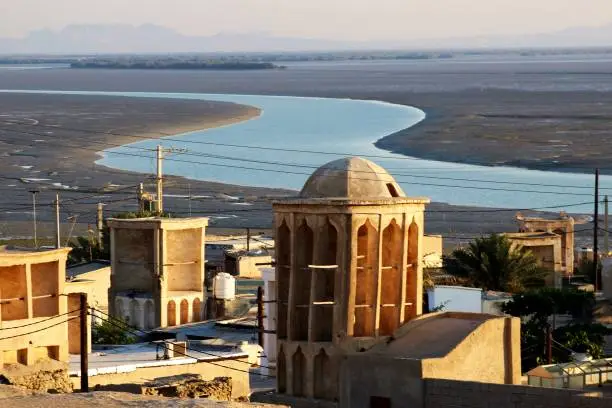
Qeshm served as a commercial relay between Persia and the Indian Ocean for millennia. The Portuguese left fortifications here in the 16th century. The local culture, known as bandar, blends Arab, African and Indian influences, visible in zar music, traditional women's masks and the architecture of houses with badgir (windtowers).
Highlights of your visit
Valley of the Stars (Chahkooh)
This salt and clay canyon, carved by water and wind, forms columns and arches in shifting hues depending on the light. Visiting in late afternoon reveals the most striking contrasts. Wear sturdy shoes: the ground is uneven.
Hara mangrove forest
Designated a UNESCO biosphere reserve, this coastal forest is accessible by boat. The Avicennia marina mangroves form a labyrinth of aerial roots. Flamingos, herons and kingfishers are frequent visitors in winter.
Kharbas caves
Cut into a cliff face overlooking the Strait of Hormuz, these caves are believed to have served as a place of worship or dwelling in the Sassanid era. The view of the sea from the cave entrance is remarkable.
Laft village
This fishing village preserves windtowers (badgir) built from rammed earth, a natural ventilation architecture typical of the Gulf. The port still welcomes wooden dhows built by traditional methods.
Photography tips
- Valley of the Stars: golden light an hour before sunset for long shadows across the clay formations.
- Mangroves: early morning for light mist and bird activity.
- Laft village: windtowers photograph well from below through narrow streets.
- No particular photography restrictions noted on natural sites; respect privacy in villages.
Location and access
Qeshm lies in the Strait of Hormuz, a few kilometers south of Bandar Abbas, capital of Hormozgan province. The ferry from Bandar Abbas is the most common connection for travelers arriving overland. Qeshm Airport receives regular domestic flights. On the island, car rental or local taxis are the most practical ways to reach the sites, which are scattered across a large area.
Nearby
- Hormoz Island — small neighboring island with red sand beaches and Portuguese fort ruins.
- Bandar Abbas — bustling port, ferry departure point, spice market and waterfront.
- Hengam Island — renowned for dolphin watching and snorkeling in clear waters.
Frequently asked questions
October to April, temperatures remain pleasant. Summer (June-August) is very hot and humid, poorly suited for hiking the geological sites.
Qeshm is a free trade zone: certain nationalities can stay without an Iranian visa for a limited period. Conditions vary by nationality and change; verify with your agency before departure.
The sites are far apart. Car rental or day taxis are the most practical options. Local agencies offer organized tours covering the main sites.
Yes. A ferry connects Qeshm to Hormoz. One day is enough to explore Hormoz Island; plan to depart early morning from Qeshm.
Yes. Despite its free trade zone status, Iranian dress codes remain in effect: headscarf mandatory for women, covered clothing for everyone.
Two to three days allow you to cover the Valley of the Stars, Hara mangroves, Kharbas caves and Laft village without rushing.