Shushtar's Historic Hydraulic System
Shushtar's Historic Hydraulic System
Dams, tunnels and mills carved into rock: the Shushtar hydraulic system, inscribed as a UNESCO World Heritage site in 2009, stands as one of the most complex ancient engineering works in the Middle East.
In Shushtar, within Khuzestan province, a network of canals, dams, mills and tunnels carved into rock comprises one of antiquity's most intricate hydraulic engineering systems. Inscribed as a UNESCO World Heritage site in 2009, this system dates primarily from the Sassanid era (3rd–7th century). It diverted waters from the Karun River to irrigate surrounding plains, power mills and create spectacular artificial waterfalls.
Quick reference
- Admission: paid entry (UNESCO-listed site)
- Recommended duration: 2 to 3 hours to explore the entire site
- Dress code: modest dress required (Iranian dress codes in effect)
- Access: central Shushtar, reachable by taxi from downtown or the bus station
- Best period: October to April, before Khuzestan's extreme heat
What to see
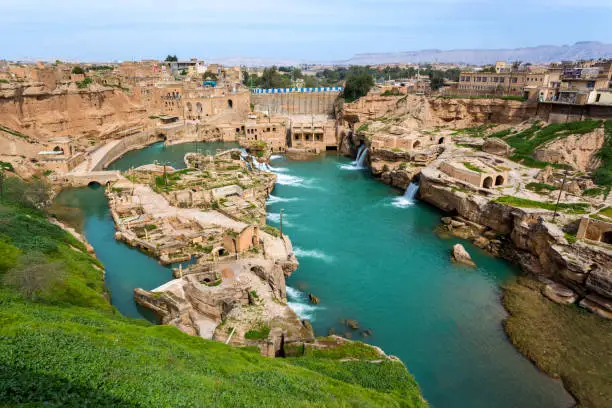
The site comprises several interdependent elements. The Band-e Kaisar dam (or Caesar's bridge-dam), partially preserved, ranks among the world's oldest bridge-dams. Tunnels carved through limestone rock distributed water into two main canals: the Gargar and Shoteit. Downstream, a series of waterfalls still powers water mills, some partially restored.
History and context
Early infrastructure dates to the Achaemenid era, but under the Sassanids—notably under Shapur I in the 3rd century—the system reached full complexity. Roman prisoners of war, including engineers, are believed to have participated in its construction, hence the popular name "Caesar's dam." The network operated continuously for over a millennium, irrigating a prosperous agricultural region.
Highlights of your visit
Shushtar's waterfalls and mills
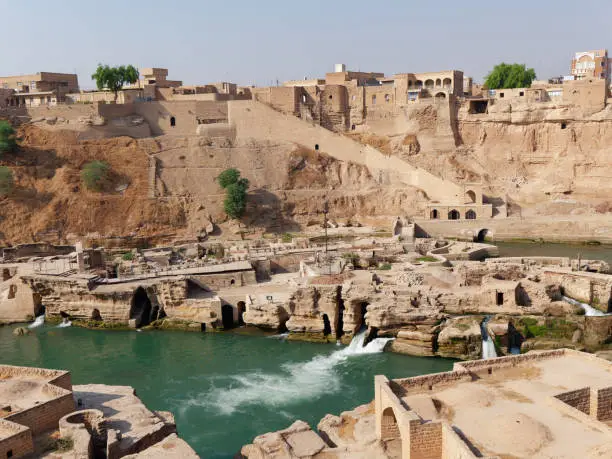
Below the rocky plateau, water flows in cascades through gates and channels. Water mills, several still operational, demonstrate the system's productive purpose. This is the site's most photographed location.
Tunnels carved through rock
Two principal tunnels, several hundred meters long, cut through limestone beneath the city. Their dimensions and precision testify to remarkable technical mastery for the era. Partial access is possible depending on water levels.
The Band-e Kaisar bridge-dam
Built across the Karun, this bridge-dam served dual purposes: holding water for distribution through canals and enabling river crossing. Its massive stone piers remain visible from the banks.
Photography tips
Morning light is ideal for photographing waterfalls without backlighting. In winter and spring, Karun discharge is stronger, making cascades more dramatic. From the terrace overlooking the mills, you capture a wide frame of the entire hydraulic network in operation.
Location and access
Shushtar lies in Khuzestan province, approximately 90 km north of Ahvaz. The city is accessible by bus from Ahvaz, which has an international airport. The hydraulic site is located in central Shushtar, within walking distance of the bazaar. Local taxis easily serve the site from the bus station.
Nearby attractions
- Susa (Shush) — ancient Elamite and Achaemenid capital, approximately 100 km away, home to the Tomb of the Prophet Daniel.
- Tchogha Zanbil — UNESCO-listed Elamite ziggurat, among the best preserved in the Middle East, accessible from Ahvaz.
- Ahvaz — Khuzestan's capital, the main transit hub with its lively Karun riverfront.
Interested in this visit?
We can include it in your personalised itinerary.