Tabatabaei House (Khaneh-ye Tabatabaei)
Tabatabaei House (Khaneh-ye Tabatabaei)
A 19th-century merchant's residence in the heart of Kashan, the Tabatabaei House unfolds four courtyards adorned with stuccos, pools and windcatchers — a showcase of Qajar residential architecture.
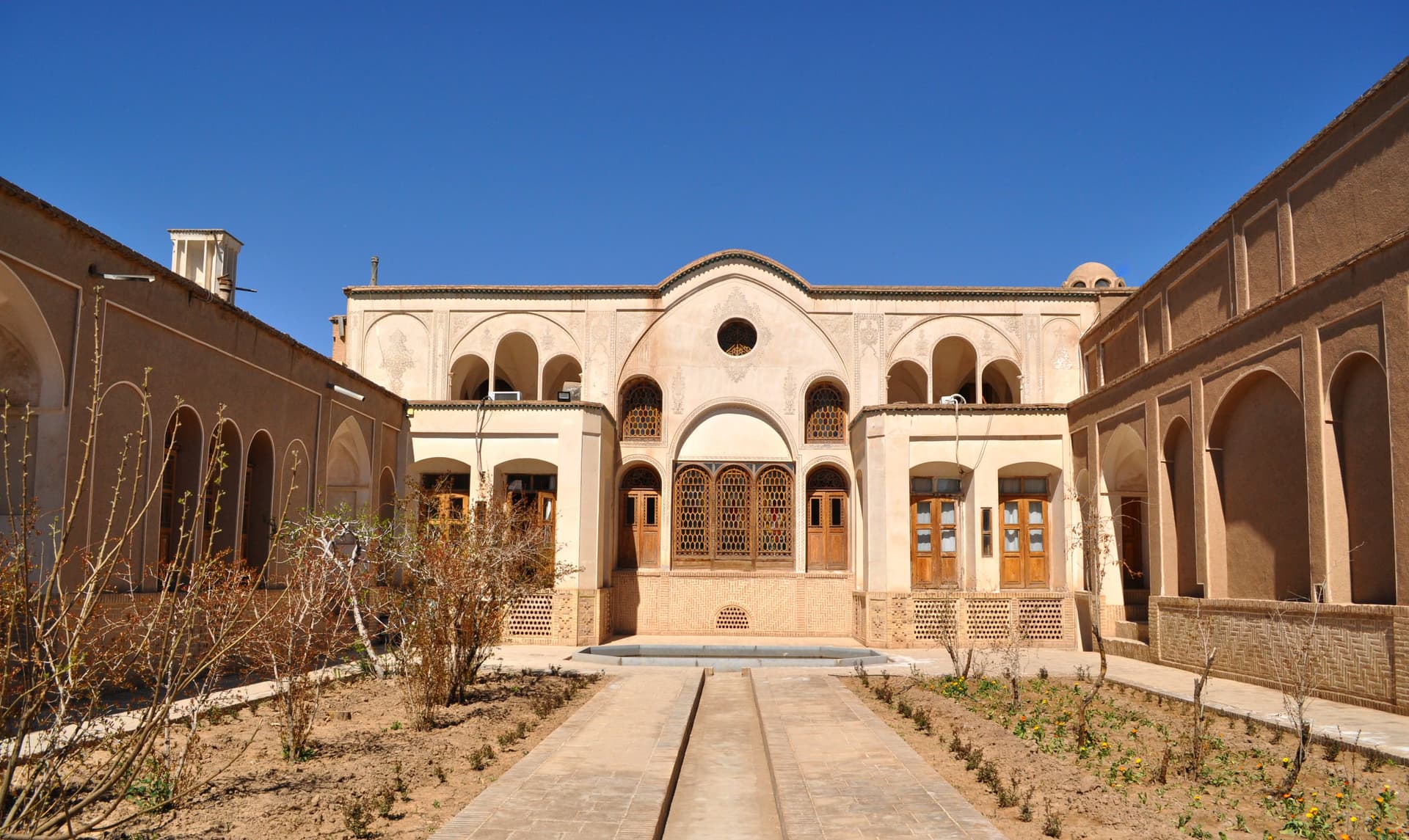
In the heart of Kashan's old city, the Tabatabaei House is one of Iran's best-preserved historic residences. Built in the 19th century for a prosperous carpet merchant family, it exemplifies the art of living among Qajar bourgeoisie: inner courtyards, pools, carved stuccos and latticed screens filtering desert light. Its size and ornamental quality make it a landmark of Persian residential architecture.
Quick Practical Info
- Entry : paid admission (Iranian national museum rate; reduced for Iranian nationals)
- Suggested duration : 1 to 1.5 hours
- Dress code : covered dress required — headscarf for women, no shorts for men
- Access : Kashan's historic quarter, walkable from the bazaar
- Accessibility : limited due to traditional thresholds and stairs
What to See
The house is organized around four interconnected inner courtyards, each with a central pool. The interior facades are covered with relief stuccos, murals and mirrors. The badgirs (windcatchers) ensure natural ventilation. The reception rooms, with their painted coffered ceilings, speak to the refinement of the Qajar period.
History and Context
The residence was built around 1880 for Seyyed Jafar Tabatabaei, a carpet merchant whose fortune rested on trade with European markets. The Tabatabaei family numbered among Kashan's great merchant dynasties, a city renowned for its carpets and silks. The house is today listed as Iran's national heritage and open to the public as a museum.
Highlights of the Visit
The Stuccos and Latticed Screens
Artisans carved plaster panels with floral and geometric motifs of remarkable finesse. The wooden latticed screens cast changing shadows depending on the hour, transforming corridors into plays of light.
The Courtyards and Pools
Each courtyard has its own character: the formal courtyard welcomed outside visitors, while the intimate courtyards were reserved for family life. The rectangular pools reflect ornate facades and cool the air in summer.
The Reception Rooms
The reception halls (talar) open onto the courtyards through large glazed arcades. Coffered ceilings, decorative niches and antique carpets recreate the atmosphere of a 19th-century bourgeois dwelling.
The Windcatchers (badgirs)
Four badgirs crown the roofline. These wind-catching towers oriented toward the northern breeze channel cool air down to underground rooms — a passive climate solution typical of Iranian desert architecture.
Etiquette and Visit Rules
- Headscarf required for women upon entry.
- Covered dress for all — shoulders and knees covered.
- Do not touch the stuccos or woodwork.
- Speak quietly in restored rooms.
Photography Tips
Light is optimal in mid-morning: the sun illuminates the main courtyard's stuccos without backlighting. Reflections in the pools are sharpest early, before visitor crowds. A wide-angle lens is useful in narrow corridors. Personal photography is permitted; check any restrictions for professional equipment at the entrance.
Location and Access
The Tabatabaei House is located in Kashan's historic quarter, a few minutes' walk from the covered bazaar and the Borujerdi House. Kashan is connected to Tehran and Isfahan by intercity bus and railway. From the station or bus terminal, taxis serve the historic center. Parking is difficult in the lanes; walking from the bazaar is preferred.
Nearby Attractions
- Borujerdi House — another Qajar residence in Kashan, celebrated for its murals and monumental windcatcher, a few minutes' walk away.
- Kashan Bazaar — historic covered bazaar where carpets, silks and worked copperware are traded.
- Fin Garden (Bagh-e Fin) — UNESCO-listed Persian garden, one of Iran's oldest irrigated gardens, at Kashan's edge.
- Agha Bozorg Mosque — 18th-century mosque and madrasa, featuring the recessed architecture characteristic of Kashan.
Frequently asked questions
Spring (March–May) and autumn (September–November) offer pleasant temperatures in Kashan. Summer is very hot in this desert-adjacent city; plan your visit for early morning.
Yes. Both residences are close to each other in the historic quarter. Allow half a day to comfortably visit both, possibly adding the Agha Bozorg Mosque.
Yes. In Iran, dress code applies in all public spaces, including museums and historic houses. Headscarf and covered clothing are required at entry.
Personal photography is generally allowed. For commercial use or with tripod, inquire with the caretaker at the entrance.
Plan between one and one-and-a-half hours to explore the four courtyards, reception rooms and underground spaces at a leisurely pace.
Local guides offer their services at the entrance or can be booked through Kashan agencies. A guide considerably enriches understanding of architectural symbolism and family history.
Interested in this visit?
We can include it in your personalised itinerary.