Tomb of Daniel (Suse)
Tomb of Daniel (Suse)
The tomb attributed to the prophet Daniel, in Shush (Susa), is one of Iran's rare interfaith pilgrimage destinations. Its distinctive white helicoid cone dominates the Shaur riverbank and draws Muslims, Jews, and Christians alike.
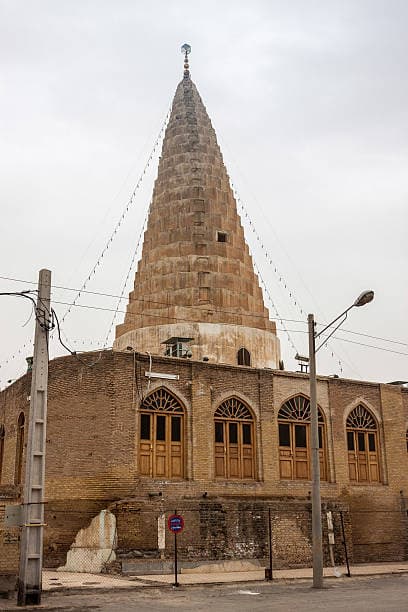
In the heart of Shush, ancient Susa, stands a mausoleum crowned with a distinctive white cone: the tomb attributed to the prophet Daniel. Venerated by Muslims, Jews, and Christians alike, this site ranks among Iran's rare truly interfaith pilgrimage destinations. Its spiral silhouette commands the Shaur riverbank and serves as a visual landmark for the entire city.
Practical information at a glance
- Access: Central Shush, a few minutes' walk from the bazaar and archaeological museum.
- Entry: Free admission to the mausoleum; a donation may be requested for certain interior areas.
- Dress code: Mandatory — women must wear a headscarf and cover shoulders and legs; shoes are removed upon entering the tomb chamber.
- Recommended duration: 30 to 45 minutes.
- Best season: Autumn and spring to avoid the extreme heat of Khuzestan.
What to see
The current building dates from the twentieth century, but it stands upon far older structures. The white helicoid cone — inspired by Mesopotamian ziggurats according to some architects — is immediately striking. Inside, a simple prayer hall precedes a cenotaph draped in green fabric, surrounded by ornate grilles. Quranic inscriptions adorn the walls. The lower crypt, accessed via a narrow staircase, houses a stone sarcophagus.
History and context
Islamic, Jewish, and Christian tradition locates the burial of Daniel, the Old Testament prophet deported to Babylon in the sixth century BCE, at this very spot. Susa was then a major Achaemenid capital. Medieval Arabic and Persian sources already mention a sanctuary here. The region's Jewish community long maintained the site, and Jewish pilgrimages are documented through the twentieth century.
Highlights of your visit
The helicoid cone
Viewed from outside, the white spiral tower contrasts strikingly with Khuzestan's flat landscape. It is unique in Iranian funerary architecture and deserves observation from various angles along the Shaur's banks.
The crypt and sarcophagus
Descending into the crypt reveals an austere, ancient stone sarcophagus. The atmosphere is contemplative; pilgrims of all faiths sometimes gather here simultaneously, a rare occurrence elsewhere in Iran.
The interfaith atmosphere
Witnessing the coexistence of Muslim worshippers and Jewish or Christian pilgrims from the diaspora creates a powerful human experience, difficult to find anywhere else in the country.
Etiquette and visiting rules
- Remove your shoes before entering the tomb chamber.
- Speak softly; the faithful pray continuously.
- Women must wear a headscarf and modest dress upon entering the complex.
- Avoid photographing people at prayer without permission.
Photography tips
Morning light is ideal for photographing the white cone from the opposite bank of the Shaur. In late afternoon, the main facade is well-lit. Inside, lighting is low; a camera with strong low-light performance is useful. Always ask permission before photographing worshippers.
Location and access
The tomb is located in central Shush (Khuzestan province), roughly 120 kilometers southwest of Dezful and about thirty kilometers from archaeological Susa. The city is accessible by bus from Ahvaz (the provincial capital) or by train. The site is walking distance from the Shush Museum and Morgan's Castle. Wheelchair access to the main chamber is possible; the crypt, with its narrow staircase, is not.
Nearby attractions
- Ruins of Susa — one of the world's oldest archaeological sites, a few kilometers away.
- Shush Museum — collections of Elamite and Achaemenid artifacts found on-site.
- Morgan's Castle — a fortress built by French archaeologists in the late nineteenth century, overlooking the site.
- Tchogha Zanbil — an Elamite ziggurat designated a UNESCO World Heritage site, approximately 40 kilometers away.
Frequently asked questions
Yes. The site welcomes Muslim, Jewish, Christian, and non-religious visitors. It is one of Iran's rare interfaith pilgrimage destinations.
Women must wear a headscarf and clothing covering shoulders and legs. Shoes are removed upon entering the tomb chamber. These rules apply to all female visitors, regardless of nationality.
Khuzestan is one of Iran's hottest regions. Choose October through April for manageable temperatures. Summer regularly exceeds 45°C (113°F).
Yes, this is the classic combination in the region. Tchogha Zanbil lies about 40 kilometers from Shush and is easily visited the same day, ideally with a hired vehicle or negotiated taxi.
Photography is generally tolerated in common areas. Avoid photographing people at prayer. In the crypt, request permission from the caretaker.
Interested in this visit?
We can include it in your personalised itinerary.