Apadana Palace of Susa
Apadana Palace of Susa
Built by Darius I around 515 BCE, the Apadana Palace of Susa stands as one of the great architectural undertakings of the Achaemenid empire. Monumental columns, glazed archer friezes, and layers of history crown the royal terrace of Khuzestan.
The Apadana Palace of Susa is one of the best-documented Achaemenid royal residences of the ancient world. Built by Darius I around 515 BCE on the terrace of Susa, in Iran's Khuzestan province, it served as the administrative capital of the Persian empire. Its remains—columns, capitals, glazed-brick friezes—bear witness to an architectural programme of unprecedented ambition, blending Babylonian, Egyptian, and Greek influences.
Practical Information at a Glance
- Access: archaeological site open to the public, on the outskirts of the city of Shush (Susa), Khuzestan province.
- Recommended duration: 1.5 to 2 hours for the site and adjacent museum.
- Dress code: Islamic dress required for women (headscarf, covering clothes).
- Accessibility: terrain partially flat but not specially adapted; wheelchair access difficult in certain areas.
What You'll See
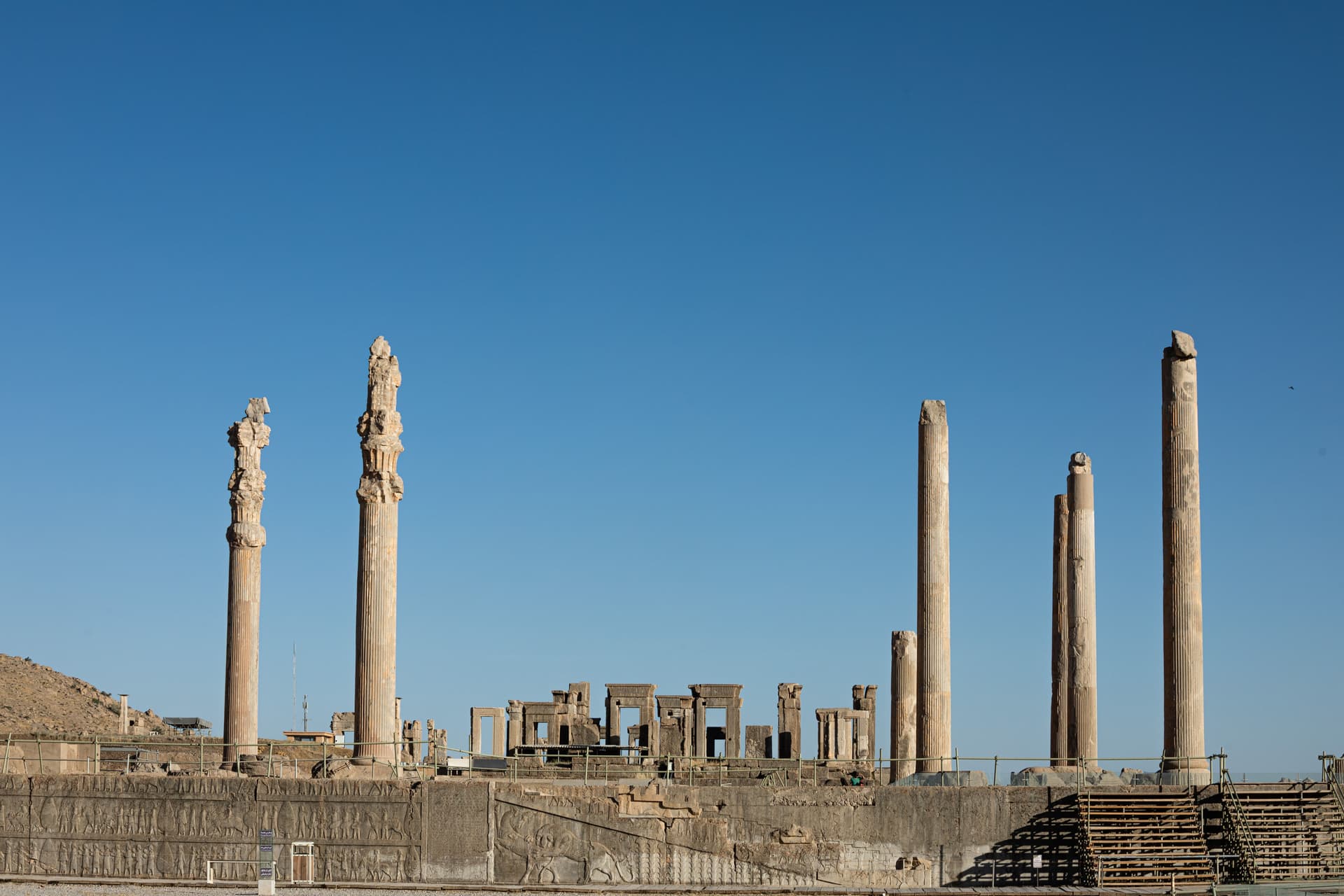
The site preserves the massive foundations of the hypostyle hall (apadana), whose columns once reached approximately 20 meters in height. The stone column bases and capitals with bicephalic bull protomes are characteristic of Achaemenid style. Glazed-brick friezes depicting archers of the royal guard—the "Immortals"—were discovered here; the originals are now housed in the Louvre and the National Museum of Iran.
History and Context
Susa has been inhabited since the 5th millennium BCE. Darius I made it his administrative capital around 521 BCE and commissioned the construction of the apadana, a great columned audience hall. A cuneiform inscription of Darius, known as the "foundation charter," details the materials and peoples mobilized for construction. The palace was expanded by Xerxes I, then partially destroyed by fire before being restored. Alexander the Great seized it in 331 BCE.
Highlights of Your Visit
The Achaemenid Column Bases
Aligned across the terrace, the limestone column bases convey the scale of the original hypostyle hall. Their arrangement allows you to visualize the floor plan of a 36-column apadana, identical in logic to that of Persepolis.
The Archer Frieze (Reproductions)
Reproductions of the famous glazed-brick frieze are displayed on site. The archers, dressed in Median or Persian garb, rendered in vivid colors against a blue ground, exemplify the technical mastery of the Babylonian artisans recruited by Darius.
Morgan's Castle
Overlooking the site, the castle built by the French archaeological mission in the late 19th century now serves as a local museum. It houses finds from the excavations: pottery, seals, cuneiform tablets, and casts of reliefs.
Photography Tips
Morning light is ideal for photographing the column bases without backlighting. In late afternoon, raking light brings out the relief of the stones. Morgan's Castle offers a vantage point overlooking the entire archaeological site. No known photography restrictions on the exterior; verify rules inside the museum.
Location and Access
The site lies on the northern outskirts of the city of Shush, approximately 130 km northwest of Ahvaz, capital of Khuzestan. Shush is accessible by bus from Ahvaz or by train (Shush station on the Tehran-Ahvaz line). Local taxis connect the station to the site. The Ziggurat of Tchogha Zanbil, a UNESCO World Heritage site, lies about 40 km to the southeast and is easily visited in combination.
In the Surrounding Area
- Ziggurat of Tchogha Zanbil — Elamite temple of the 13th century BCE, one of the best-preserved of the ancient Near East.
- Tomb of Daniel — mausoleum revered by the three Abrahamic religions, located in the heart of Shush.
- Museum of Shush (Morgan's Castle) — archaeological collections from French excavations of the 19th and 20th centuries.
Frequently asked questions
Khuzestan is extremely hot in summer, with temperatures exceeding 45 °C. The months from October to April offer far more pleasant conditions for visiting the outdoor site.
No. The original glazed-brick panels were removed during French excavations and are now primarily housed in the Louvre Museum in Paris and the National Museum of Iran in Tehran. Reproductions are displayed at the Susa site.
Yes, this is the classic pairing in the region. The two sites are approximately 40 km apart. A taxi or rental vehicle allows you to visit both in a single day from Shush.
Signage on site is limited. A local guide or organized tour through an agency greatly facilitates understanding of the palace layout and its Achaemenid history.
As throughout Iran, women must wear a headscarf and clothing that covers the arms and legs. This requirement applies both at the archaeological site and in the museum.
Interested in this visit?
We can include it in your personalised itinerary.