Vank Cathedral (St. Mary the Mother of God)
Vank Cathedral (St. Mary the Mother of God)
At the heart of Isfahan's Armenian Jolfa district, Vank Cathedral brings together lavish biblical frescoes, Safavid architecture, and a museum documenting the history of Iran's Armenian community since the 17th century.
At the heart of the Armenian Jolfa district in Isfahan, Vank Cathedral stands as the most iconic monument of Iran's Armenian community. Built in the 17th century under the Safavids, it blends Armenian architecture with Persian influences in a singular ensemble: turquoise domes, lavish biblical frescoes, and an adjoining museum documenting the history of a people displaced and then rooted.
Practical Information at a Glance
- Admission: paid entry (museum included with ticket)
- Closed: Mondays
- Recommended duration: 1 to 1.5 hours (cathedral + museum)
- Dress code: modest attire required; women must cover their hair
- Access: Jolfa district, reachable by taxi or on foot from central Isfahan
What You'll See
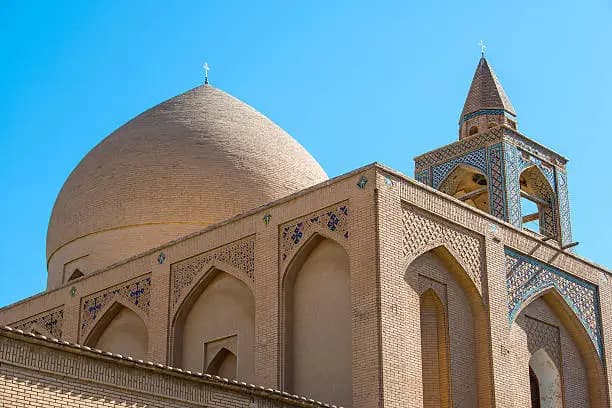
The exterior strikes visitors with its restraint: ochre brick, blue dome, discreet bell tower. The interior contrasts sharply. From floor to vault, 17th-century frescoes blanket every surface — scenes from the Old and New Testaments, remarkably detailed depictions of the Last Judgment. Persian faience tiles sit beside inscriptions in classical Armenian.
History and Context
In 1604, Shah Abbas I deported thousands of Armenians from Julfa (present-day Azerbaijan) to Isfahan to develop the silk trade. He granted them the Jolfa district and freedom of worship. Vank Cathedral — meaning "monastery" in Armenian — was founded in 1606 and expanded throughout the 17th century. It became the spiritual and cultural center of Iran's Armenian diaspora, a role it maintains today.
Highlights of Your Visit
The Interior Frescoes
Created by Armenian artists trained in Byzantine tradition and influenced by Safavid art, they form a complete narrative cycle. The Last Judgment scene on the western wall is particularly detailed: the damned and the blessed are rendered with rare expressiveness.
The Adjoining Museum
Vank Cathedral's museum preserves illuminated Armenian manuscripts, ancient liturgical objects, documents on the 1915 Armenian Genocide, and a 17th-century printing press — among the first introduced to Iran. It's a precious historical resource, often overlooked by hurried visitors.
The Garden and Bell Tower
The enclosure includes a tranquil garden, several secondary chapels, and a bell tower whose silhouette stands apart from the surrounding minarets. The whole forms a preserved Armenian microcosm amid an Iranian city.
Etiquette and Visiting Rules
- Women must wear a headscarf covering their hair, even within the site grounds.
- Modest attire required for all (shoulders and knees covered).
- The cathedral is an active place of worship: respect silence during services.
- Photography is generally permitted inside, but check posted guidelines on-site.
Photography Tips
Natural light penetrates the nave sparingly: bring a camera with strong low-light performance or use a tripod if permitted. Ceiling frescoes photograph best in wide-angle from the center of the nave. Late morning brings lateral light through the windows, illuminating the iconostasis's gilding.
Location and Access
Vank Cathedral stands in the Jolfa district, on the south bank of the Zayandeh River, about 2 km southwest of Naqsh-e Jahan Square. The district is accessible by taxi from downtown. Jolfa concentrates several Armenian churches, art galleries, and cafés — plan time to wander after your visit.
Nearby Attractions
- Naqsh-e Jahan Square — Isfahan's historic heart, with the Imam Mosque and Ali Qapu Palace.
- Imam Mosque — a Safavid architectural masterpiece, a few kilometers north.
- Si-o-Se Pol Bridge — a Safavid bridge with 33 arches spanning the Zayandeh, a short walk from Jolfa.
- Khaju Bridge — another historic 17th-century bridge, upstream of Si-o-Se Pol.
- Chehel Sotoun Palace — the Palace of Forty Columns, with gardens and Safavid frescoes.
Interested in this visit?
We can include it in your personalised itinerary.