Rayen Citadel (Arg-e Rayen)
Rayen Citadel (Arg-e Rayen)
Arg-e Rayen, a mud-brick citadel in southeastern Iran, stands among the world's finest preserved adobe fortresses. Less famous than Bam, it offers an authentic immersion into medieval caravan-route architecture.
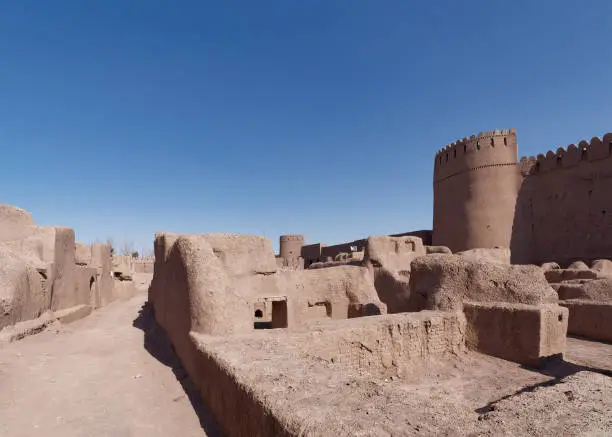
Some 100 kilometers southeast of Kerman, the Rayen Citadel (Arg-e Rayen) ranks among the world's finest preserved adobe fortresses. Constructed from rammed earth and straw, it sprawls across several hectares at the foot of Mount Hezar. Long overshadowed by the celebrated Arg-e Bam, it nonetheless offers a comparable experience—and far less crowded—set within striking desert terrain.
Practical essentials at a glance
- Admission: paid entry (modest fee, in Iranian rials)
- Recommended duration: 1.5 to 2 hours to explore the entire site
- Dress code: covered attire required for women (hijab); closed-toe shoes recommended on uneven surfaces
- Access: by car from Kerman via the Jiroft road; no direct public transport—arrange a taxi or rental vehicle
- Best season: spring (March–May) and autumn (September–November) to avoid extreme heat
What to see
The citadel divides into two main zones: the upper city (governor's residence, watchtowers, bathhouse) and the lower city (residential quarters, bazaars, mosque). Narrow alleys, earthen domes, and round towers remain remarkably intact. Several rooms still preserve their wall niches and natural ventilation systems.
History and context
Arg-e Rayen traces its origins to the Sassanid era, spanning more than 1,500 years of history. It remained inhabited until the mid-19th century, when it was abandoned following an earthquake. Unlike Bam, it escaped the devastating 2003 quake and thus retained much of its original structure, without extensive reconstruction.
Highlights of your visit
The governor's residence
Perched in the citadel's upper section, this dwelling concentrates the finest architectural elements: raw brick arches, interior courtyards, and surveillance towers offering sweeping views across the desert plain.
Traditional bathhouse (hammam)
The citadel's hammam illustrates the builders' ingenuity: domes pierced with glass skylights for illumination without excess heat, gently sloped floors for water drainage.
The inner bazaar
Ancient shops lined along the lower city's narrow streets provide precise insight into daily life in a medieval caravan town. The acoustics and natural coolness are remarkable.
Etiquette and visit rules
- Hijab is mandatory for women at the entrance and throughout the site.
- Do not climb walls or towers: adobe structures are fragile.
- Respect marked areas; certain rooms may be closed for preservation.
Photography tips
Golden light at sunrise and sunset reveals the raw earth's textures beautifully. The lower city's alleys offer striking play of shadow and light. From the upper city's towers, the contrast between the ochre citadel and surrounding desert is compelling. Photography is permitted throughout the site.
Location and access
Rayen lies approximately 100 km southeast of Kerman. The road is paved and passable in a standard car. No regular bus service serves the site directly; a shared taxi from Kerman or a rental vehicle remains the most convenient option. The village of Rayen, adjacent to the citadel, has basic shops.
In the surrounding area
- Bam Citadel (Arg-e Bam) — another major adobe fortress in the region, UNESCO-listed, roughly 200 km away.
- Shazdeh Garden (Mahan) — UNESCO-listed Persian garden, about 50 kilometers northwest.
- Mausoleum of Shah Nematollah Vali (Mahan) — 15th-century Sufi complex, striking architecture.
- Lut Desert (Dasht-e Lut) — UNESCO natural site, one of the planet's hottest places, accessible from Kerman.
Frequently asked questions
Spring (March to May) and autumn (September to November) are ideal. In summer, temperatures in this desert region can exceed 40°C (104°F), making visits exhausting.
The most direct route from Kerman covers roughly 100 km. Without regular bus service, a taxi or rental vehicle is necessary. Some local agencies offer excursions combining Rayen and Mahan.
Both are adobe citadels, but Bam was largely destroyed in the 2003 earthquake and partially rebuilt. Rayen, spared the quake, retains more original structures. It is also far less crowded.
Yes, photography is generally permitted throughout the citadel. No particular restrictions apply to personal cameras.
Yes. From Kerman, one day allows you to visit Rayen in the morning and Shazdeh Garden or the Mahan mausoleum in the afternoon, provided you start early and have a vehicle at your disposal.
Interested in this visit?
We can include it in your personalised itinerary.