Si-o-se-pol Bridge (Allahverdi Khan Bridge)
Si-o-se-pol Bridge (Allahverdi Khan Bridge)
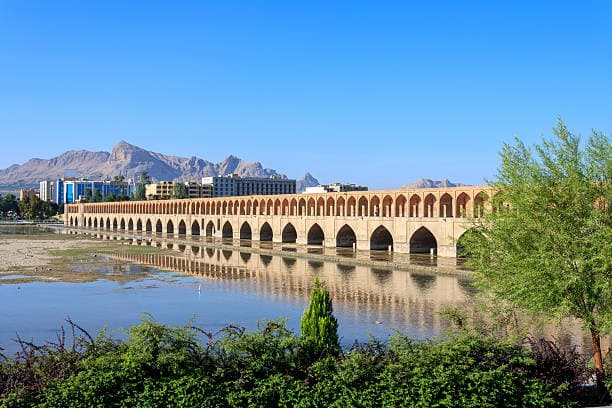
The Si-o-se-pol, a thirty-three arch bridge built in the early 17<sup>th</sup> century, is the social heart of Isfahan. Its lower galleries, river reflections, and vibrant local life make it far more than a simple monument.
The Si-o-se-pol spans the Zayandeh Rud river south of Isfahan. Built under the Safavids in the early 17th century, this thirty-three arch bridge is simultaneously an architectural masterpiece, a public promenade, and a hub of social life. Isfahanis gather here in the evening to walk, chat, or simply listen to water echoing beneath the vaults.
Practical information at a glance
- Access: free entry, accessible on foot from the city center
- Suggested duration: 30 to 60 minutes to cross and wander beneath the arcades
- Dress code: no specific requirements (public space, non-religious)
- Accessibility: the central roadway is accessible, but lateral galleries feature steps
What to see
The bridge extends nearly 300 meters and features thirty-three arches — the number that inspired its Persian name (si-o-se meaning "thirty-three"). Two levels of galleries run the entire length: the lower level, at water's edge, offers distinctive acoustics and welcome coolness in summer. Stone benches invite visitors to sit facing the current.
History and context
The bridge was commissioned by Allahverdi Khan, commander-in-chief of Shah Abbas Ist's army, and completed around 1602. It served simultaneously as a traffic bridge, a dam regulating river levels, and a royal pleasure pavilion. This dual function — technical and aesthetic — is characteristic of Safavid architecture.
Highlights of your visit
The lower galleries at water's edge
Descending to the lower level transforms the experience entirely: city noise fades, replaced by the gentle lapping of water between the pillars. Local groups sometimes gather here to sing or recite poetry — an informal tradition that endures.
The sunset crossing
In late afternoon, low-angle light gilds the bridge's ochre bricks and reflects across the river. This is when the promenade is most animated and the light most favourable for photography.
The bridge as social stage
The Si-o-se-pol is as much a living space as a monument. Families, students, and elderly residents share the bridge each evening. Observing this everyday Iranian sociability is itself a travel experience.
Photography tips
Golden late-afternoon light is ideal. From the south bank, you can frame all thirty-three arches in succession. From the north bank, the bridge's reflection in the water is particularly sharp when water levels are sufficient. Inside the lower galleries, a wide-angle lens captures the perspective of repeated vaults. Photography is unrestricted throughout the site.
Location and access
The bridge lies south of Isfahan's historic center, at the far end of Chahar Bagh boulevard. It is accessible on foot from Naqsh-e Jahan Square (Naqsh-e Jahan Square) in about twenty minutes. Khaju Bridge, another Safavid bridge in the city, sits roughly 2 km upstream on the same river.
Nearby attractions
- Khaju Bridge — Isfahan's other grand Safavid bridge, adorned with paintings and featuring a central chamber used as a royal pavilion.
- Naqsh-e Jahan Square — a massive UNESCO-listed royal square, surrounded by the Shah Mosque, Sheikh Lotfollah Mosque, and Ali Qapu Palace.
- Shah Mosque (Masjed-e Shah) — a Safavid ceramic masterpiece, at the southern end of Naqsh-e Jahan Square.
- Isfahan's Grand Bazaar — a network of covered galleries extending from Naqsh-e Jahan Square, ideal for local crafts.
Frequently asked questions
Yes, bridge access is completely free and open year-round.
Spring (March-May) and autumn (September-November) offer pleasant temperatures. In summer, the coolness of the lower galleries is an asset, though river levels may be low or intermittent depending on the year.
The Si-o-se-pol is a public, non-religious space. Standard Iranian dress conventions apply (headscarf for women), but no additional restrictions specific to the site.
Yes. The two bridges are about 2 km apart along the river. A riverside walk allows you to connect them easily in half a day.
Yes, without restriction. The lower galleries and views from the riverbanks are the most sought-after angles.
A complete round-trip crossing with gallery exploration takes 30 to 60 minutes. Allow more time if you wish to sit and observe the local activity.
Interested in this visit?
We can include it in your personalised itinerary.