Tchogha Zanbil (Chogha Zanbil)
Tchogha Zanbil (Chogha Zanbil)
Tchogha Zanbil houses one of the best-preserved ziggurats of the ancient Near East, built around 1250 BC by Elamite king Untash-Napirisha. Iran's first UNESCO-listed site, it can be visited from Susa or Ahvaz.
Tchogha Zanbil is an Elamite religious complex erected around 1250 BC by king Untash-Napirisha, in the Khuzestan plain in southwestern Iran. Its five-level ziggurat — one of the best-preserved in the ancient Near East — towers above a complex of temples, enclosures and palaces buried beneath the earth. Designated a UNESCO World Heritage site in 1979, the site bears witness to the power of Elamite civilization at its height.
Practical info at a glance
- Entrance: paid admission (ticket required on-site)
- Suggested duration: 1.5 to 2 hours to explore the complex
- Dress code: respectful attire required; women must cover their hair and wear loose-fitting clothing
- Access: by car from Susa (Shush) or Ahvaz; no direct public transport to the site
- Best time to visit: October to March (extreme heat in summer)
- Accessibility: terrain partly flat around the ziggurat, but access to upper levels not adapted for mobility restrictions
What you'll see
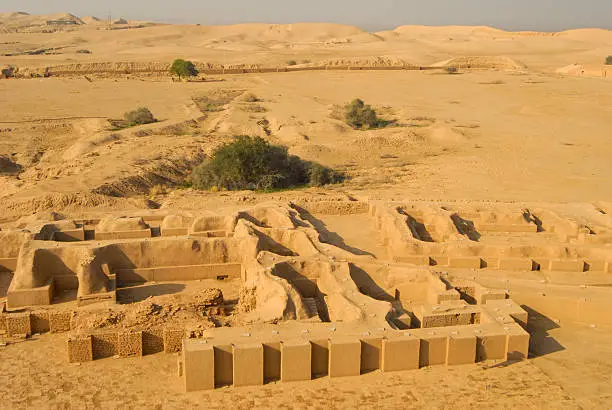
The heart of the site is the ziggurat itself: a stepped tower of terracotta bricks, standing approximately 25 meters high today (estimated at 50 meters originally). Three concentric enclosures surround it. The first encloses the tower and its temples dedicated to the Elamite gods Inshushinak and Napirisha. The two outer enclosures delimit ancient royal palaces and funerary hypogea.
Thousands of bricks still bear cuneiform inscriptions bearing Untash-Napirisha's name. Certain structures reveal sophisticated water-supply systems, including an aqueduct several kilometers long that fed the sacred city.
History and context
Untash-Napirisha founded the sacred city of Al-Untash-Napirisha ("the city of Untash-Napirisha") around 1250 BC to unify the worship of Elamite gods. Construction stopped upon the king's death; the city was never fully inhabited. Assyrian king Assurbanipal looted and partially destroyed it around 640 BC.
The site remained buried beneath sediments until French excavations led by Roman Ghirshman between 1951 and 1962 revealed the complex's extent. Its UNESCO listing in 1979 made it Iran's first site recognized by the organization.
Highlights of your visit
The ziggurat
The five-level tower remains the site's central monument. Unlike Mesopotamian ziggurats built in successive terraces, this one was constructed from inside to outside, each level forming an independent tower. This Elamite building technique is unique. The inscribed bricks, visible at eye level, constitute exceptional epigraphic testimony.
Temples and sanctuaries
Within the first enclosure, several small temples flank the ziggurat. Their ground plans remain legible. Votive objects — figurines, jewelry, tablets — were found here during excavations and are now kept in Tehran's National Museum and the Susa museum.
Royal palaces and hypogea
In the third enclosure, vestiges of royal palaces include vaulted hypogea where members of the Elamite royal family were buried. These underground tombs, built of fired brick, are among the rarest preserved examples of Elamite funerary architecture.
The hydraulic system
An aqueduct conveyed water from the Dez River to the complex. Sedimentation basins and brick canals are still visible on the site, illustrating the technical mastery of Elamite engineers.
Photography tips
Morning light (before 10 AM) and late afternoon (after 4 PM) are ideal: they sculpt the relief of the bricks and avoid the flat whites of overhead sun. From ground level, a slightly upward angle emphasizes the ziggurat's verticality. Cuneiform inscriptions on the bricks photograph well in raking light. No known photography restrictions for visitors.
Location and access
Tchogha Zanbil lies approximately 45 km southeast of Susa (Shush) and about 80 km northeast of Ahvaz, capital of Khuzestan. The road from Susa is paved and passable by standard car. From Ahvaz, shared taxis serve Susa; from Susa, you'll need to hire a taxi or rent a vehicle to reach the site. No regular bus service runs directly to Tchogha Zanbil.
Nearby attractions
- Susa (Shush) — ancient Elamite and Achaemenid capital, with its archaeological tell, museum and the Tomb of the Prophet Daniel.
- Haft Tappeh — Elamite site predating Tchogha Zanbil, with an on-site museum displaying cuneiform tablets and reliefs.
- Ahvaz — major city in Khuzestan, a logistical hub for the region, known for its historic bridges over the Karun River.
Frequently asked questions
October to March. Khuzestan is one of Iran's hottest regions: in summer, temperatures regularly exceed 45°C, making outdoor visiting very challenging. Spring (March-April) is pleasant but can turn hot by April.
Access to the upper levels is restricted for conservation reasons. Visitors can generally access the first level and walk around the base. Rules may change; ask the on-site guardian for current conditions.
Yes. In Iran, Islamic dress codes apply everywhere: women must wear a headscarf and clothing covering the arms and legs. Comfortable shoes are recommended for walking on the site's uneven terrain.
Yes, this is the classic itinerary. Susa and Tchogha Zanbil can be visited in one full day from Ahvaz, or over two half-days if you stay in Shush. Plan for a private vehicle to link the two sites efficiently.
A small visitor center provides information about the site, but major artifacts from the excavations are housed in Tehran's National Museum and Susa's archaeological museum. A visit to the latter usefully complements your discovery of Tchogha Zanbil.
Yes, photography is allowed for visitors. No particular restrictions are noted for personal cameras. Avoid midday hours for better images of the brick textures.
Interested in this visit?
We can include it in your personalised itinerary.