Pasargades
Pasargades
Pasargades, founded by Cyrus the Great in the 6th century BC, preserves the king's tomb, columned palaces, and traces of the earliest Persian gardens. An unmissable UNESCO site in Fars Province.
Pasargades is the first capital of the Achaemenid Empire, founded by Cyrus the Great in the 6th century BC in the Morghab plain, Fars Province. Inscribed as a UNESCO World Heritage site since 2004, the site preserves the tomb of Cyrus, columned palaces, and royal gardens among the oldest in the world. It is here that the very idea of the Persian empire takes shape.
Quick practical facts
- Entrance: paid (separate ticket from Persepolis)
- Recommended duration: 1.5 to 2 hours to explore the entire site
- Dress code: proper attire required; women must wear a headscarf
- Access: by car or taxi from Shiraz (approximately 130 km to the northeast) or from Persepolis (approximately 43 km)
- Wheelchair accessibility: terrain partly flat but not equipped; difficult wheelchair access
What you'll see
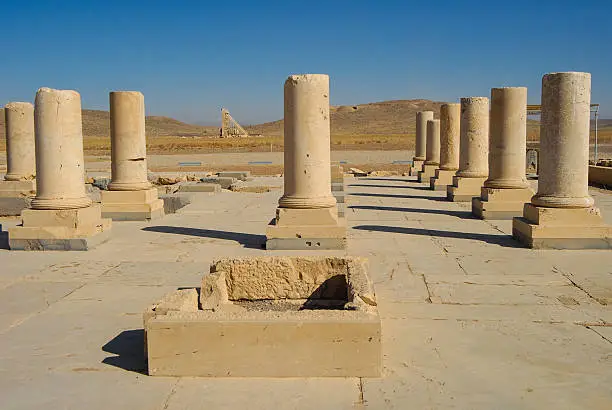
The site extends across a vast arid plain. The main remains are scattered over several hundred meters: the tomb of Cyrus, the ruins of the audience palace, the residential palace, a temple tower (Zendan-e Soleiman), and a fortified terrace (Tall-e Takht). The royal gardens, considered the prototype of the Persian four-part garden (chahar bagh), are also visible as archaeological traces.
History and context
Cyrus II founded Pasargades around 550 BC following his victory over the Median king Astyages. The city became the symbolic heart of the empire, though Darius I would later move the capital to Persepolis. Alexander the Great visited Cyrus's tomb during his conquest and ordered its restoration—testimony to the respect the Macedonian conqueror held for the Achaemenid founder. The site remained largely buried until 20th-century excavations.
Highlights of your visit
The tomb of Cyrus
A limestone structure set upon six stone steps, standing about 11 meters high. The burial chamber is accessible through a small opening. Its simplicity contrasts with the grandeur of the empire it symbolizes. It is one of the best-preserved funerary monuments of the ancient Near East.
The audience palace (Apadana)
Isolated columns still standing, some bearing trilingual inscriptions in Old Persian, Elamite, and Babylonian. The bases of columns with double bulls prefigure the style that would flourish at Persepolis. The reliefs of winged guardians on the jambs are among the earliest examples of Achaemenid art.
Tall-e Takht
A fortified terrace dominating the plain, built of stone blocks assembled without mortar. Its exact purpose—palace, treasury, or temple—remains debated. The view from the summit over the entire site and the Morghab plain is breathtaking.
Zendan-e Soleiman
A square stone tower, twin to the Ka'ba-ye Zartosht at Naqsh-e Rostam. Its function (fire temple, tomb, or archive repository) is not definitively established. It illustrates Achaemenid monumental architecture in its early stages.
Photography tips
Morning light is ideal for Cyrus's tomb: low-angle sunlight brings out the joints between limestone blocks. Late afternoon is perfect for the audience palace columns silhouetted against the sky. Avoid midday in summer: the plain is very exposed and the light is harsh. No known photography restrictions exist for outdoor areas of the site.
Location and access
Pasargades is located in Fars Province, approximately 130 km to the northeast of Shiraz and about 43 km to the north of Persepolis. The road between the two sites is paved and accessible by standard tourist vehicles. No regular direct bus service is known; a taxi or car with driver from Shiraz remains the most common solution. Local agencies often offer a combined itinerary of Persepolis + Pasargades + Naqsh-e Rostam in one day.
In the surrounding area
- Persepolis — The ceremonial capital of the Achaemenid Empire, with its sculpted terraces and monumental gateways, approximately 43 km to the south.
- Naqsh-e Rostam — Royal necropolis carved into the cliff, with the tombs of Darius and Xerxes, near Persepolis.
- Shiraz — City of poetry and gardens, the logical starting point for visiting the Fars region.
Frequently asked questions
Spring (March–May) and fall (September–November) offer pleasant temperatures. Summer is very hot on the Morghab plain; bring water and sun protection if visiting between June and August.
Yes, it is the most common itinerary from Shiraz. Plan a full day for both sites, starting with Pasargades in the morning and finishing at Persepolis in the afternoon, or vice versa.
A guide is not mandatory, but it is strongly recommended. Explanatory signs on the site are limited; an English-speaking local guide or an agency like Nomadays allows you to contextualize the remains and avoid missing less obvious features.
Yes. Women must wear a headscarf and clothing covering the arms and legs, in accordance with Iranian regulations applicable to all tourist sites in the country.
The terrain is generally flat between monuments but unimproved (dirt and gravel ground). Wheelchair access is difficult; no specific disabled accessibility facilities are reported on the site.
Photography outdoors is permitted with no known restrictions. Check local rules at the time of your visit, as they may change.
Want to discover this destination?
Our local advisors design your tailor-made trip.