Abyaneh
Abyaneh
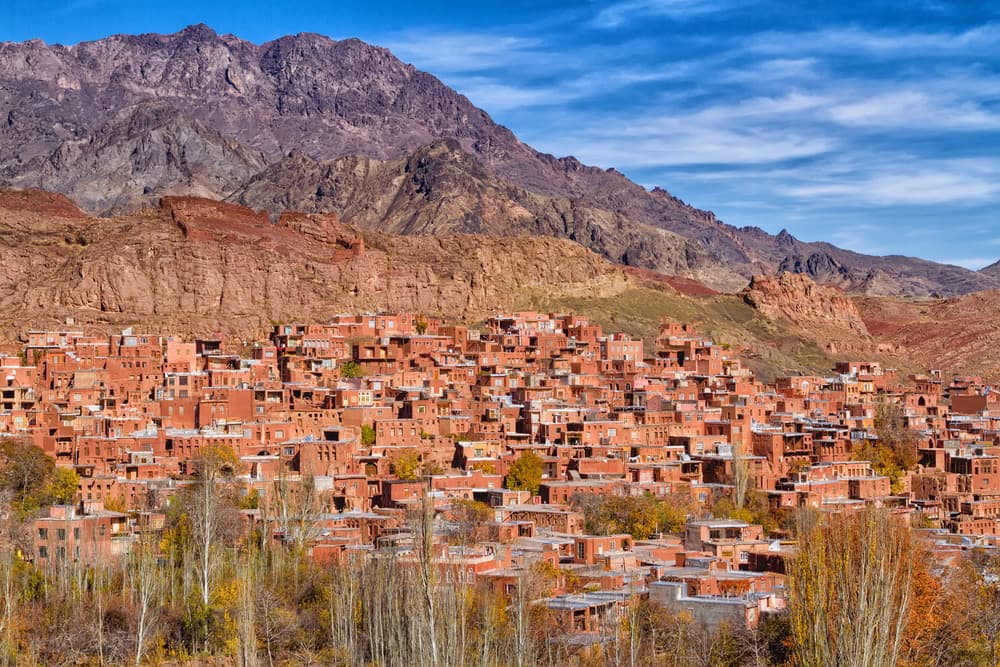
A red clay village perched at 1,500 m between Kashan and Isfahan, Abyaneh preserves traditional Safavid architecture and is listed as a national monument.
Abyaneh is a mountain village located in Isfahan province, midway between Kashan and Isfahan, perched at approximately 1,500 meters elevation. Its red clay houses, clinging to the side of a valley, earned it a place on Iran's national monuments list. Here's what you need to know before visiting.
Why visit Abyaneh
The village stands out for its red clay architecture, a material extracted locally that gives the facades their characteristic ochre hue. Houses cascade down the hillside one above the other, forming a dense urban fabric where doors and windows are deliberately kept small. Multiple roof openings capture light and complete an architectural system designed for mountain climate.
Beyond its built environment, Abyaneh preserves a local dialect (Abyanaki) and dress traditions that older residents still wear daily. The village has been listed since 2006 on Iran's national monuments register, making it a recognized cultural stop between Kashan and Isfahan.
History of Abyaneh
Early inhabitants settled around the Barzrud River, fed by springs from the Karkas mountain range. This reliable water supply enabled the development of terraced agriculture, which formed the basis of the village economy for centuries.
The village reached its golden age under the Safavid dynasty (16th–17th centuries). Rulers commissioned three fortresses to protect the valley from raids. Only ruins remain today, still visible on the heights. This period also saw the construction or restoration of several religious buildings, including the Hajatgah mosque.
The entire village fabric reflects centuries of adaptation to mountain terrain: steep slopes, limited water resources, harsh winters. On August 1, 2006, the site was officially registered on Iran's national monuments list.
What to see in Abyaneh
The red clay houses
The village's main attraction remains its domestic architecture. Facades built from red clay mud organize themselves into dense housing where each structure leans against the next. Wooden doors are adorned with inscribed poems, floral motifs, and inscriptions naming the owner or builder. Inside, small rooms often serve multiple functions.
Jameh Mosque
Located in the Myun Deh district, Jameh Mosque is one of the village's oldest religious buildings. Its prayer hall preserves remarkable woodwork, particularly on the mihrab.
Hajatgah Mosque
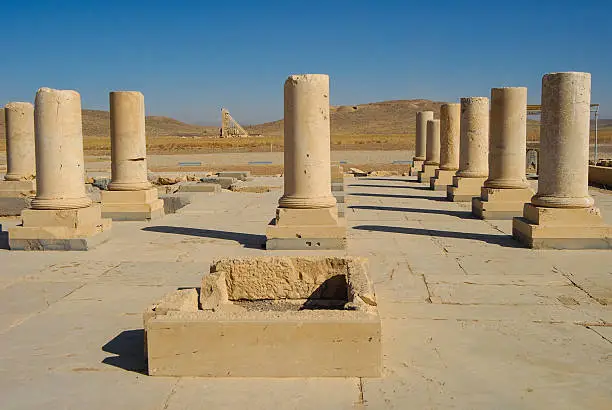
Built during the Safavid era, Hajatgah Mosque features a columned prayer hall topped with ornate capitals. It stands as a direct witness to the village's prosperous period.
Ruins of Safavid fortresses
Three fortresses built to defend the valley survive as ruins on the heights. A short hike allows access to some and offers a sweeping view of the entire village.
Nashubad archaeological site
Nearby, the Nashubad site displays older remains and complements a visit for those interested in the region's settlement history.
Local life and economy
Abyaneh's economy rests on subsistence farming, fruit cultivation, and livestock. Orchards produce plums, pears, apples, apricots, and walnuts, sold locally or consumed within families. Depending on the season, you may encounter residents harvesting fruit or threshing wheat. A few shops sell dried fruits, herbs, and local crafts.
Practical information
- Visit duration: plan 2 to 3 hours to walk the alleys and main buildings, a half-day if you hike up to the fortresses.
- Footwear: bring sturdy shoes; the alleys are paved and steep.
- Entry fee: a modest ticket is required at the village entrance.
- Accommodation: a few traditional guesthouses allow overnight stays.
When to go
The climate is shaped by altitude. From October to April, temperatures can drop well below freezing and rainfall is frequent. The recommended period extends from May to August, with dry weather and mild temperatures around 20 to 25°C during the day. Late spring highlights the orchards in bloom; summer allows for extended evening walks.
How to get there
Abyaneh is located in Isfahan province, near Natanz, and midway between Isfahan and Kashan. Several options:
- By bus: public lines depart from Isfahan or Kashan to the region, often with a change in Natanz.
- Private car with driver: the most convenient option, allowing you to combine Abyaneh with other stops along the route.
- Organized tour: many agencies offer Abyaneh as a day trip from Isfahan or Kashan.
What to see in the region
If you extend your stay around Isfahan and Kashan, several sites complement an Abyaneh visit well:
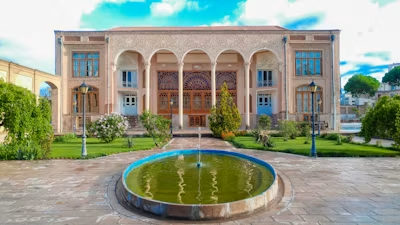
- The traditional Boroudjerdi residence in Kashan, a refined example of Persian domestic architecture.
- Fin Garden, a UNESCO-listed Persian garden near Kashan.
- Dowlatabad Garden, another remarkable Persian garden.
- Gondab, a less-visited regional stop.
Frequently asked questions
Frequently asked questions
A half-day is enough to explore the village, its mosques, and a few hillside paths. Plan a full day if you combine the visit with Natanz or Kashan.
Yes, several traditional guesthouses have been set up in former village homes. It's a worthwhile option to enjoy the site in the evening after tour groups depart.
May to August. The rest of the year, the altitude (1,500 m) brings low temperatures and possible snowfall in winter.
They are built from clay mud extracted locally, whose reddish ochre tone gives the village its uniform appearance. This material offers good thermal mass suited to the mountain climate.
It's possible but lengthy: the journey requires several hours round-trip. Better to include the visit in a route between Kashan and Isfahan.
Plan your Iran trip
Abyaneh fits naturally into an itinerary connecting Kashan, Natanz, and Isfahan. To build a custom itinerary and receive tailored advice, consult our Iran travel packages.
Interested in this visit?
We can include it in your personalised itinerary.