Omar Khayyam Mausoleum
Omar Khayyam Mausoleum
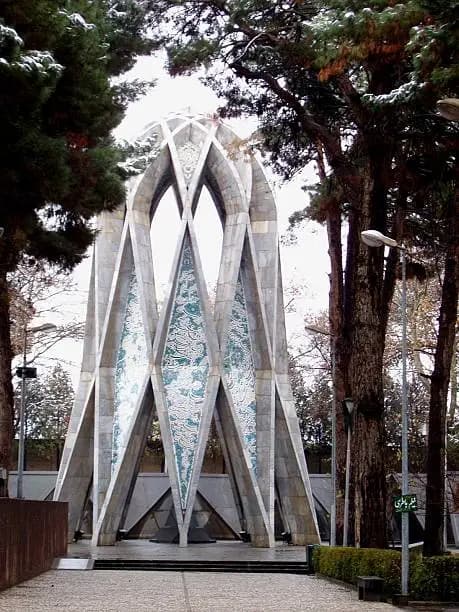
In Nishapur, the Omar Khayyam Mausoleum houses the tomb of the poet of the Rubaiyat within a garden of roses. The modernist structure designed by architect Hooshang Seyhoun makes it a singular monument of Khorasan.
In Nishapur, a city of Khorasan-Razavi, the Omar Khayyam Mausoleum marks the burial place of the Persian poet, mathematician, and astronomer (1048–1131). Author of the Rubaiyat, Khayyam stands as a central figure in Iranian culture and world literature. The current monument, designed by architect Hooshang Seyhoun, strikes a distinctly contemporary form within a garden planted with cypresses and roses.
Quick reference
- Admission: fee applies (modest rate, in Iranian rials)
- Suggested duration: 30 to 45 minutes
- Dress code: smart casual recommended; while not an active place of worship, respect is expected
- Access: central Nishapur, reachable by taxi or local transport from the bazaar
What to see
The tomb itself is sheltered beneath a concrete shell structure, designed by Hooshang Seyhoun in the 1960s—the same architect who designed Avicenna's Mausoleum in Hamadan. The stone funerary slab bears verses from the Rubaiyat. The surrounding garden, serene and shaded, invites leisurely walks among rose beds, the emblematic flower of Persian poetry.
History and context
Omar Khayyam was born in Nishapur around 1048. A recognized mathematician, he contributed to the reform of the Persian solar calendar (the Jalali calendar, still in use in Iran today). His quatrains (rubaï)—translated into English by Edward FitzGerald in 1859—earned him worldwide renown. Nishapur, an ancient metropolis of the Silk Road, is also home to the tombs of Attar and the poetess Mahsati Ganjavi.
Highlights of the visit
Seyhoun's structure
The monument's modernist architecture—a pierced concrete shell allowing light to filter through—deliberately contrasts with classical Iranian mausoleums. It symbolizes Khayyam's intellectual openness. The interplay of light inside, depending on the hour, is particularly striking.
The inscribed verses
Quatrains in Persian are carved into the stone tomb. Even without reading Farsi, the contemplative atmosphere of the space and the ornamental calligraphy deserve attention.
The garden
The wooded park surrounding the mausoleum is a cherished place for strolls among residents. Roses, cypresses, and fountains compose a setting conducive to contemplation, faithful to the spirit of the Rubaiyat.
Photography tips
Morning light, raking across the surfaces, highlights the reliefs of the concrete structure and the interplay of shadows in the garden. The interior of the shell offers a graphic composition with the slab illuminated by overhead openings. Photography is permitted in the garden and inside the monument.
Location and access
The mausoleum is located in central Nishapur, a few minutes' walk from the main bazaar. Nishapur is accessible from Mashhad (approximately 120 km to the west) by road or train. From Mashhad, regular buses and shared taxis serve the city. The site is at ground level and generally accessible, though full wheelchair accessibility is not guaranteed.
In the immediate vicinity, the Mausoleum of Attar in Nishapur is within a few minutes' walk.
In the surroundings
- Mausoleum of Attar — tomb of the great Persian mystical poet Farid ud-Din Attar, a few hundred meters away.
- Nishapur Bazaar — traditional market where one finds notably Nishapur turquoise, renowned throughout Iran.
- Sanctuary of Imam Reza in Mashhad — the world's largest Shiite religious complex, approximately 120 km to the east.
Frequently asked questions
Spring (March–May) is ideal: the garden's roses bloom and temperatures in Nishapur are mild. Autumn is also suitable. Summer can be hot in the Khorasan region.
The mausoleum is not an active place of worship, but Iranian dress conventions apply: women should wear a head covering and modest clothing; men should avoid shorts.
Yes. The Mausoleum of Attar is within a few minutes' walk. A half-day is enough to visit both tombs and explore the bazaar. Nishapur is easily visited as a day trip from Mashhad.
Photography is generally permitted in the garden and inside the monument. It is advisable to check with the custodian on site, as regulations may change.
Thirty to forty-five minutes are sufficient for the monument and garden. Allow more time if you wish to linger over the inscribed verses or simply enjoy the tranquility of the park.
Interested in this visit?
We can include it in your personalised itinerary.