Gondab
Gondab
In Abarkuh, the funerary tower Gonbad-e Aali, built in 1056, exemplifies Seljuk architecture in dry stone. The first listed monument in Yazd Province.
About a hundred kilometers southwest of Yazd, the funerary tower Gonbad-e Aali dominates the heights of Abarkuh. Built in the 11th century to house the tomb of a Daylami dignitary, it represents the first listed monument in Yazd Province and one of the best-preserved examples of dry stone architecture in central Iran.
Why visit Gonbad-e Aali
The site offers several points of interest for travelers with a passion for Iranian history. It is first and foremost the first monument inscribed in Yazd Province's cultural heritage, making it a key reference for those interested in the status of Iranian cultural properties. It is also a remarkable example of dry stone construction, without mortar—a technique imposed by water scarcity in this desert region. Finally, its elevated location offers an unobstructed view of Abarkuh and the surrounding plain, once a caravan stop on the salt trade route.
Site history
The tower was built in 1056 on the orders of Hassan Ibn Firouzan, a descendant of the Daylami dynasty, who administered Yazd under Seljuk authority. The monument was erected to house the tomb of Amir Amid al-Din Shams al-Dawlah, who was related to Firouzan by family ties (sources mention a close kinship link, sometimes described as grandfather to grandson).
The building reflects the period of Seljuk expansion in central Iran, marked by a flourishing of monumental funerary towers. At Abarkuh, builders worked according to dry stone construction principles: blocks were assembled without mortar, with water conservation dictating this technical constraint. Nearly a millennium later, the tower still stands, having survived several earthquakes.
What you can see on site
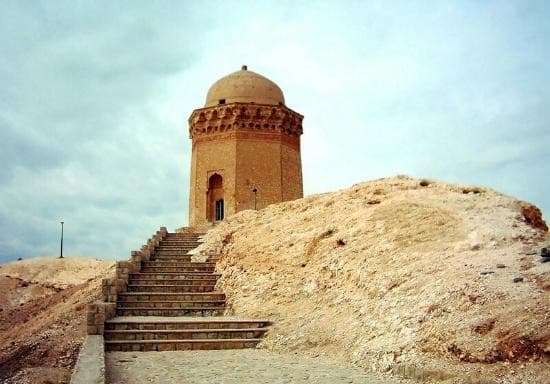
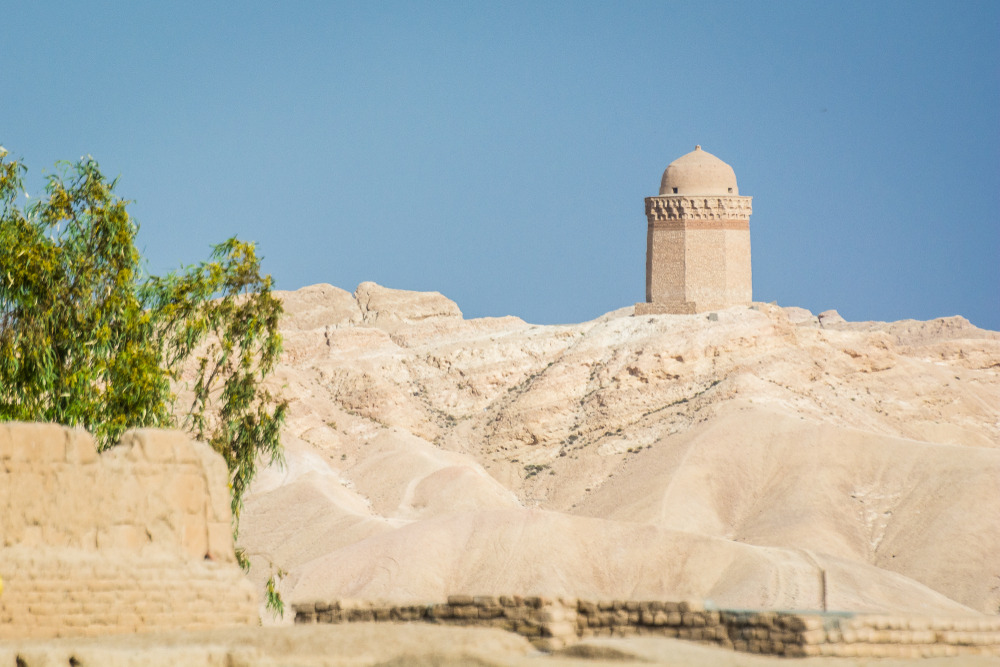
The monument presents itself as a vertical structure 22 meters high with walls 2 meters thick, perched on a rocky promontory. The ochre façade stands out distinctly against the mineral landscape.
Plan and elevation
The building adopts an octagonal plan, common in Iranian funerary towers from the Seljuk period. The entrance is reached by a flight of steps carved into the rock.
The decoration
At the summit, the honeycomb-shaped dome is the most recognizable element of the silhouette. Just below, a carved cornice runs along the entire perimeter, marking the transition between the tower's body and the cupola. The façades bear geometric motifs and Kufic inscriptions, an ancient Arabic script characteristic of this period.
The panorama
From the platform, views extend over the city of Abarkuh, its outskirts, and the desert plain bordering the first hills. Allow 30 to 60 minutes on site to walk around the monument and enjoy the vantage point.
Practical information
- Visit duration: 30 minutes to 1 hour is sufficient.
- Site access: the climb is on foot via stairs; bring sturdy footwear.
- Entry fee: modest entrance fee for foreign visitors, payable on site in rials.
- Water: no water source at the monument's base; bring something to drink.
When to visit
Abarkuh is located in an arid climate zone. Autumn and spring (October–November, March–April) offer the most comfortable conditions, with mild days and cool nights. Winter is also feasible: daytime temperatures remain manageable, though mornings can be cold.
If possible, avoid the period June through mid-September, when afternoons regularly exceed 35°C (95°F) and make the climb to the monument arduous. For photography, late afternoon light particularly enhances the ochre tone of the façade.
How to get there
Abarkuh is located approximately 140 km southwest of Yazd, on the road linking Yazd to Shiraz. The city is accessible by car or bus from three major Iranian destinations:
- from Yazd: about 2 hours of driving;
- from Shiraz: allow 3 to 4 hours;
- from Isfahan: about 4 to 5 hours.
Many travelers include Abarkuh as a stop on the route between Yazd and Shiraz. Once there, the site can be reached by taxi from the city center in just a few minutes.
Nearby attractions
Abarkuh, home to nearly 30,000 residents, preserves several vestiges that warrant a longer stay than just visiting the tower:
- historic ice houses (yakhchal), conical structures of sun-dried brick designed to preserve ice during summer;
- the Cypress of Zoroaster, touted as one of the oldest trees on the planet; local tradition links it to Japhet, son of Noah;
- Abarkuh's Jameh Mosque, an ancient building with understated decoration;
- tile and ceramic workshops, perpetuating local craftsmanship.
To extend your journey through central Iran, you can then visit Dowlatabad Garden in Yazd, or continue toward Kashan to see the Boroudjerdi traditional residence and Fin Garden. The picturesque village of Abyaneh is another recommended stop on the central itinerary.
Frequently asked questions
Frequently asked questions
Allow 30 minutes to 1 hour on site, including the climb. If combining the visit with other Abarkuh sites (ice houses, cypress, Jameh Mosque), plan for a half-day.
The tower was built in 1056 under Seljuk administration. It houses the tomb of Amir Amid al-Din Shams al-Dawlah and was commissioned by Hassan Ibn Firouzan, a descendant of the Daylami dynasty.
The region's aridity made it impossible to secure the water needed to produce mortar. Builders therefore assembled blocks without binding material—a demanding technique that also explains the monument's resistance to earthquakes.
Abarkuh is approximately 140 km southwest of Yazd, about 2 hours by road. You can take a bus from Yazd's terminal or hire a taxi, often as part of a combined excursion toward Shiraz.
Favor spring (March–April) or autumn (October–November). Summer is extremely hot in this desert zone, and the foot climb to the monument can be strenuous in full daylight.
Prepare your trip to Iran
Gonbad-e Aali fits naturally into an itinerary connecting Yazd to Shiraz, or more broadly into an exploration of the Iranian plateau and its historic cities. To build a tailored itinerary, consult our Iran travel suggestions.
Interested in this visit?
We can include it in your personalised itinerary.